

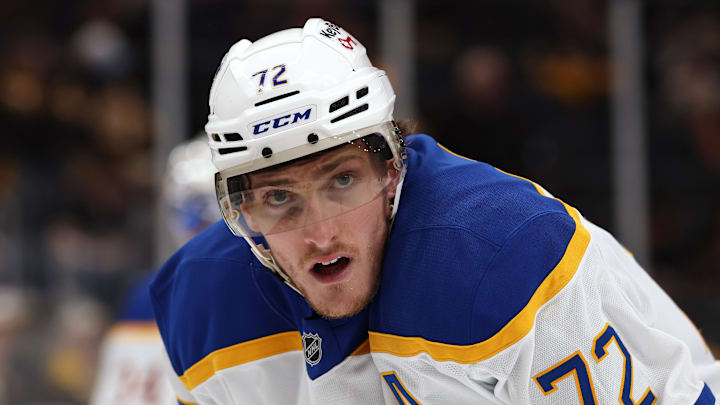
The Buffalo Sabres vs. Montreal Canadiens second-round series will be one defined by a lot of factors.
It will be a series defined by experience and inexperience, by offense and defense, and by scoring and conceding goals.
Those may seem simple enough to understand on the surface, but only a deep dive can expand these unique dynamics and allow fans to grasp their true significance and how big of a role they will play in deciding the outcome of this second-round matchup.
There are a plethora of player matchups that best represent these factors, but I picked out the three most important and most underrated contests that will define the series as a whole, which kicks off Wednesday at KeyBank Center.
Tage Thompson vs. Nick Suzuki could confirm which franchise-defining trade was more impactful
Over the course of two months, two league-altering trades took place.
On July 1, 2018, the St Louis Blues acquired forward Ryan O'Reilly as part of a trade that sent Tage Thompson, the team's first-round draft pick in 2018, to Buffalo alongside other pieces like center Patrik Berglund.
Thompson's first two seasons would see him split time between the NHL and the Sabres' AHL affiliate in Rochester. After recording 14 points in a COVID-altered 2020-21 campaign, Thompson would record at least 60 points in four of the next five seasons; his 2022-23 campaign would see him put up 94 points, while his 2025-26 campaign would once again see him pass the 80-point mark. Through his first six NHL playoff games, Thompson has recorded a total of seven points, including two goals and five assists.
Just two months after Thompson was traded, on September 10, 2018, the Vegas Golden Knights acquired longtime Canadiens forward Max Pacioretty in exchange for Tomas Tatar, a second-round pick in the 2019 NHL Draft, and a certain forward named Nick Suzuki.
That same forward went on to make the roster for the 2019-20 campaign before posting 41 points in 71 games during the regular season. He also recorded seven goals and nine assists during the Habs' run to the Stanley Cup Final in 2021 (how has it already been five years since that run?). Suzuki has also acted as the Habs' captain since 2022 and is coming off of his first 100+ point season, which included 29 goals and 72 assists.
Both Thompson and Suzuki have taken on key roles for their respective clubs over the past several seasons. But they have never had the chance to go head-to-head and prove their true value to the clubs that acquired them. Only then can the NHL world see which blockbuster trade was truly the most consequential, and this series could easily shape future perceptions of the moves made.
Who will Josh Anderson fight? Jason Zucker could step up with Sam Carrick's short-term status uncertain
Remember last year's first round series between the Canadiens and the Eastern Conference-topping Washington Capitals?
In Game 3 of that series, a 6-3 win for the Habs, Josh Anderson and Tom Wilson (who actually was the neighbor to one of my good friends) engaged in a highlight-reel fight that closed the second period on a high and set the tone for a dominant third period by the Habs.
But if one watches Anderson play hockey, they'll know he isn't just a guy who drags his team into games by fighting people. He's a very passionate member of the franchise, a good forechecker, and someone who will rely on the physical side of the game to win puck battles. In fact, Habs forward Florian Xhekaj (who is currently with their AHL affiliate, the Laval Rocket) cited Anderson as an inspiration through his work ethic.
With regard to the Sabres, forward Sam Carrick was brought in to provide a boost in the physicality department. He did just that at several points following his trade from the New York Rangers while also fighting guys like Tampa Bay Lightning forward Scott Sabourin during "The most eventful NHL game in decades."
But Carrick is still hurt, and head coach Lindy Ruff recently confirmed that him and Noah Ostlund would more than likely miss the duration of the second round. That said, Carrick returned to practice Tuesday and is now listed as day-to-day ahead of Game 1.
So who's going to step up and take on guys like Anderson?
My personal prediction is Jason Zucker. He's long been a player who can inject energy into a club and win board battles at a consistent rate. He also spends a lot of time in the offensive zone, almost eight percent more than the NHL average during these playoffs, so expect him to be part of the charge when it comes to punishing zone exits, pinning the Habs back and, by extension, getting under their skin. If Zucker can achieve the third factor to a tee, then expect plenty of post-whistle scuffles and maybe some fighting penalties.
That said, one could also make a case for a handful of Sabres to take on Anderson in hand-to-hand combat. Defenseman Logan Stanley is a fair pick to do so; one of his most recent fights came against Ottawa Senators captain Brady Tkachuk in an early-April road contest.
The battle of the blue lines will be defined by Lane Hutson and Rasmus Dahlin
Part of Montreal's success in Game 7 against the Tampa Bay Lightning came from their ability to punish Tampa Bay's commitment to defending the boards.
Columbus Blue Jackets coach Rick Bowness and the NHL on TNT panel actually did a good job explaining this during the broadcast of that game on Sunday. They said that the Habs are a scary team when they have time to shoot the puck and that Tampa Bay needed to put 100% commitment into swarming the puck if they were to pursue that strategy. Otherwise, they would be risking leaving the Montreal points time to shoot the puck or make a play.
Considering that the two big names on Montreal's defense are Lane Hutson and Noah Dobson, the Sabres must decide whether to commit to winning puck battles or defending the blue line. If they choose the former, they must be able to match or, if possible, overpower the Habs along the boards and win the majority of the puck battles that take place. Losing a puck battle could easily allow a Habs player to get the puck to a blueliner, giving the Sabres not that much time to get into position and goaltender Alex Lyon an "uh oh" moment as if it was a Wile E Coyote experiment gone wrong.
If the Sabres opt to defend the blue line and put pressure on the likes of Hutson and Dobson, they can control how many pucks get through to Montreal's top scorers and reduce the number of shots getting through to Lyon.
The good news is that the Habs' defensemen scored just 43 goals this season, which is good for 10th in the NHL. That is a top-ten metric, but it's also a solid 12 goals behind the Sabres, whose 55 goals by defensemen are second only to the Columbus Blue Jackets. That means that just under 20% of the Sabres' 288 goals scored during the regular season were scored by defensemen, while 15% of Montreal's 283 goals scored during the 2025-26 campaign came from blueliners.
The Sabres' goal-scoring metrics can be seen to hold true for the first round of the playoffs. Of the 20 goals scored by the Sabres during their first-round series against the Bruins, six of them were scored by defensemen.
But it's actually the inverse for the Habs; just two of the 16 goals scored against Tampa Bay came from defensemen, with both of them being scored by Hutson.
This is where defenseman Rasmus Dahlin comes into play. After scoring 19 goals during the regular season, the second-most of his career, Dahlin was held off the scoresheet during five of the six games played against the Bruins. But his goal early in Game 5 gave the Sabres a significant jump; despite ultimately losing the game, Dahlin's goal would end up being enough for the team to get the game into overtime. It's also worth noting that Dahlin recorded three points during the final two games of series, a tally that includes his goal in Game 5.
In terms of his role during this series, he'll have to help the Sabres' defenders set the offensive standard for the series. If they can help the offense score goals, then they'll easily be able to force Montreal to chase games and find scoring across their own lineup, something that hasn't necessarily materialized throughout the postseason as of yet.
 Add us as a preferred source on Google