

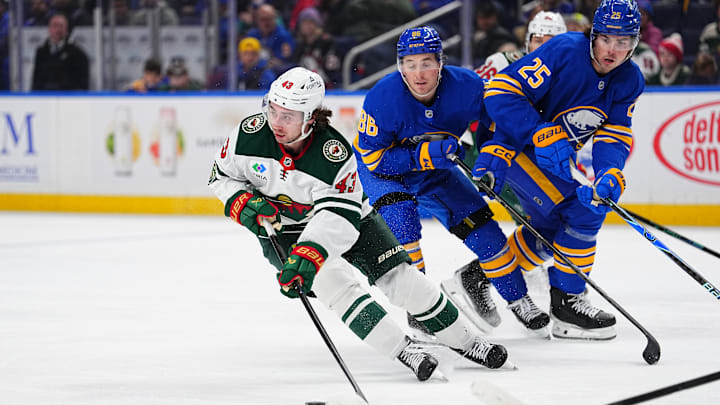
The Buffalo Sabres were looking for their 16th win in the past 18 games, but wouldn't get the win as they fell to the Minnesota Wild, but did come away with one point as the game would go to overtime. It was a game where the Sabres were seemingly playing catch-up as they fell behind 1-0 in the first and then 3-1 in the second.
However, they would bounce back and score three straight to take a 4-3 lead before the end of the second period. Their lead was short-lived as the Wild scored less than a minute later to tie the game at four.
It was a quiet third period with neither team scoring, and the game would go to overtime. However, the Sabres were trying to kill a penalty at the start of overtime, and Mats Zuccarello would score the game-winner before the penalty expired.
The Sabres will now hit the road for a Monday afternoon game against the Carolina Hurricanes and they will look to get back into the win column.
Penalties, penalties, and more penalties
It was a penalty-filled game for both teams as they combined for seven power play opportunities and 30 penalty minutes. For the Sabres, it was Michael Kesselring who led the way with nine penalty minutes in his first game back from injury.
He was handed four minutes pretty early in the game after being called for unsportsmanlike conduct along with Marcus Foligno, as they dropped the gloves right as Ryan McLeod scored in the first period. However, no punches were thrown, and they took care of the unfinished business as soon as the penalty expired to head right back into the penalty box.
The Sabres have seen a notable increase in penalty minutes, as this was now the fourth game in the past five that they have had double-digit penalty minutes after having only two games in the 13 games prior to that. This is a problem because teams are capitalizing on the power play, as the Sabres have allowed four goals in the past five games.
The biggest penalty came at the end of the third period when Peyton Krebs would be called for hooking. The Wild would have the extra man advantage in the overtime period and were able to capitalize with the game-winning goal.
Sabres allowed too many high-danger chances against the Wild
For most of the season, the Buffalo Sabres have done a good job limiting their opponent's high-danger chances. Entering Saturday, the Sabres allowed the 10th fewest in 5v5 situations, but the Sabres didn't have many answers to slowing down the Minnesota Wild in this part of the ice.
The Wild finished the game with 17 high-danger chances in 5v5 situations, converting two of them into goals. Meanwhile, the Buffalo Sabres were only able to muster 10, but they were more successful, as they had three high-danger goals on seven fewer chances.
This is an area that the Wild are pretty good at, so it shouldn't be too much of a concern, but it absolutely was a big factor in the outcome of this game.
Buffalo Sabres depth delivers with three goals
During this recent stretch of games, the Sabres have been led by their stars as Tage Thompson, Alex Tuch, and Josh Doan have been doing a lot of the heavy lifting in terms of goals. While Tuch did get a goal against Minnesota, the other goals came from their depth in Ryan McLeod, Jack Quinn, and Peyton Krebs.
McLeod was credited with the Sabres' first goal of the game after he crashed the net and the puck deflected off the Wilds' defenseman's skate to beat Filip Gustavsson. In the second, the Sabres would be down 3-1 before Peyton Krebs and Jack Quinn added goals to tie it up at three.
It is good to see in games that the stars aren't scoring; they have other players who can step up and produce.
 Add us as a preferred source on Google