

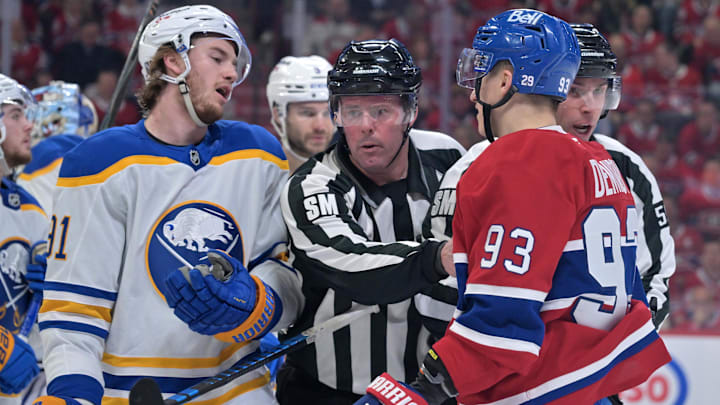
By now, it's clear that this first-time playoff roster has learned to start games quite well.
The Buffalo Sabres' first few playoff games since ending their longstanding postseason drought would see the team struggle to do just that. The Bruins weren't exactly capable of completely breaking the Sabres early in games, but the Sabres would concede the opening goal in each of the first three games of the series.
Since then, the Sabres have consistently opened games on the front foot. Five of the Sabres' last six games have seen them score the opening goal, with all five occasions coming before the 10-minute mark of the first period.
Beyond that point, it has been a far different story. In Game 4 against the Habs, the momentum shifted in Montreal's favor right after Habs head coach Martin St. Louis successfully challenged for goaltender interference on a Jack Quinn goal that wasn't initially called as such, but rather required Toronto to intervene and request a review of the play.
From that point, Montreal would earn control of the game, but Buffalo was ultimately able to get it together and win the game, sending the series back to Western New York tied at one game apiece. But barring an ability to pull off a performance akin to the one they mounted in Game 4 against Boston, the Sabres need to learn how to play a complete game.
The good news is that Buffalo's Game 4 performance showed that they can do exactly that; outside of Buffalo's early-game success, both the power-play and face-off performance can be seen to show the path forward for the team.
Buffalo's trip to La Belle Province helped revive the power play
With the power play starting to look functional once again, the true impact of the special teams units can finally be seen. After converting one of their four attempts in Game 3, Buffalo's power play earned a bit of luck on Tuesday night, with the first of two power play scores being a highlight-reel goal that would easily frustrate hockey YouTuber Steve Dangle.
Now that I think about it, that goal kind of reminds me of Claude Giroux's center-ice goal back in 2022 against the Vegas Golden Knights.
Memories aside, Zach Benson — who celebrated his 21st birthday on Thursday — recorded the second power-play goal and, by extension, the game-winning score.
With that pair of goals in mind, Buffalo's power play is now at 5-for-16 in the series, which converts to a 31.3% power play percentage. The penalty kill has also been able to make a difference, successfully navigating all but four of those situations.
In a more general sense, the two power-play goals scored on Sunday essentially acted as the difference between victory and defeat, while Game 1 would have headed to overtime had it not been for the Sabres scoring twice with the numerical advantage. As a result, one can argue that the Sabres need to keep the power play going if they are to sustain any advantage over the Habs during this best-of-three stretch.
Faceoff numbers help Montreal negate Buffalo's special teams resurgence
While Buffalo has earned a slight advantage over Montreal in the special teams discussion, it's the Habs who have almost completely bested the Sabres in terms of faceoffs.
Three of the four games played in the series thus far have seen Montreal win more faceoffs than Buffalo; all three were by considerable margins. Game 1 saw Montreal win 32 faceoffs (63% win percentage) to Buffalo's 19 (37%); when Montreal outshot Buffalo 11-1 in the third period, they won nine faceoffs to Buffalo's six. Game 3 would also see Montreal completely outclass Buffalo in the faceoff circle, winning 38 faceoffs to Buffalo's 23. That included the Habs doubling up the Sabres on even strength face-offs, with 32 faceoff wins of such nature to Buffalo's 14. The lone exception so far was Game 4, which saw Buffalo only just win that stat category 32 faceoffs to Montreal's 29 while improving their win percentage in even-strength situations.
A team's ability to win faceoffs doesn't necessarily correlate with the final score of a given game; only slight positive correlations can be seen in this regard. But the Habs are currently the second-best faceoff team in the playoffs and the best of the remaining seven teams, while the Sabres sit in last place in that same metric. Habs captain Nick Suzuki also leads all players in face-off wins with 117, with two other Habs recording at least 80 face-off wins.
Possession is also key in this regard, and Buffalo is only slightly better than Montreal when it comes to preventing defensive zone giveaways. That and the above statistics have been key in Montreal's ability to win faceoffs and use those faceoff victories to pin Buffalo back and create scoring chances.
Going forward, if the Sabres are to win the series, they are going to need to either find a way to win more often when in the faceoff circle or make the most of their faceoff wins. Whether its an offensive zone faceoff win to set up possession on a power play or a defensive zone faceoff win to relieve pressure on the defense, the Sabres need to complement their resurgent power play with a strong faceoff presence.
 Add us as a preferred source on Google