

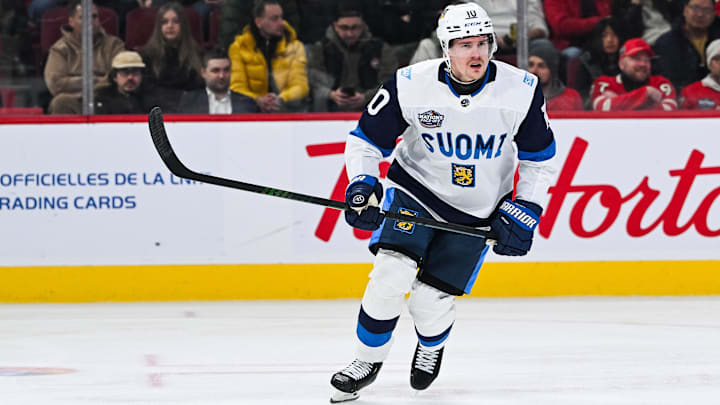
NHL players are back in the Olympics, and the first goal of the men's hockey tournament at the 2026 Milano Cortina Games came with Finland defenseman Henri Jokiharju looking lost in front of his own net. Buffalo Sabres fans are not surprised.
Finland turned the puck over along the wall and, instead of attacking Slovakian puck carrier Juraj Slafkovsky, Jokiharju decided to take away the pass while allowing the Montreal Canadiens budding superstar to walk right to the front for an easy finish:
The FIRST GOAL of the Men's #WinterOlympics Tournament has been score by Juraj Slafkovský! 💪 pic.twitter.com/3Qtx0K7gYz
— NBC Olympics & Paralympics (@NBCOlympics) February 11, 2026
It was a mind-boggling defensive decision but Jokiharju, who currently plays for the Boston Bruins, made no shortage of those while playing the first six years of his NHL career with the Sabres.
The 26-year-old Finnish defender ranked 130th out of 157 NHL defensemen who played at least 2,000 minutes at 5-on-5 in expected goals against per 60 minutes (2.75 xGA/60) across his final three seasons in Buffalo, according to Natural Stat Trick.
Jokiharju did have occasional promising moments as a puck-mover and play-creator during his time with the Sabres, but his play in the defensive zone was frequently frustrating.
Slovakia proceeded to upset Finland in the Olympic opener, 4-1.
Buffalo Sabres can learn from the Henri Jokiharju situation as key roster decisions loom
For years, Sabres fans begged the team's front office to move on from Jokiharju but former general manager Kevyn Adams continued to show confidence in the 2017 first-round draft pick. His faith never paid off as the blueliner was often a net negative for the Blue and Gold.
Buffalo finally dealt away the Finn ahead of last season's trade deadline, but it only received a fourth-round pick in return, which showcased how far his stock had fallen.
Current Sabres GM Jarmo Kekalainen should take note of Jokiharju's failed tenure, which was part of a larger problem during the Adams Era.
The club made a habit of retaining ineffective players — Jordan Greenway and Jacob Bryson are a few other examples — which not only took up valuable salary-cap space but also blocked roster spots from young prospects aiming to reach the NHL.
Kekalainen is staring down some difficult roster decisions, both leading up to this season's trade deadline and heading into the offseason, and the financial crunch will be a serious factor, especially if the front office wants to re-sign Alex Tuch.
The Sabres shouldn't feel like they must re-sign certain impending free agents. Peyton Krebs (RFA), Beck Malenstyn (UFA) and Bryson (UFA) may no longer fit into the equation. Non-tendering Krebs and letting the other two hit the open market may be necessary.
Fourth-line and third-pair players have a role, but paying them raises and taking up valuable cap space is rarely the best roster-building decision. Those spots should be filled with team-friendly contracts to leave the maximum amount of money available for key contributors like Tuch (UFA) and Zach Benson (RFA).
Adams always operated with an extreme fear that trading away certain players or prospects would come back to haunt the franchise. It did in obvious cases like Jack Eichel and Sam Reinhart but you aren't going to sink your organization by moving on from modest depth pieces.
Jokiharju is a perfect example, and his glaring mistake for Finland at the Olympics shows not much has changed over the past 11 months.
 Add us as a preferred source on Google