

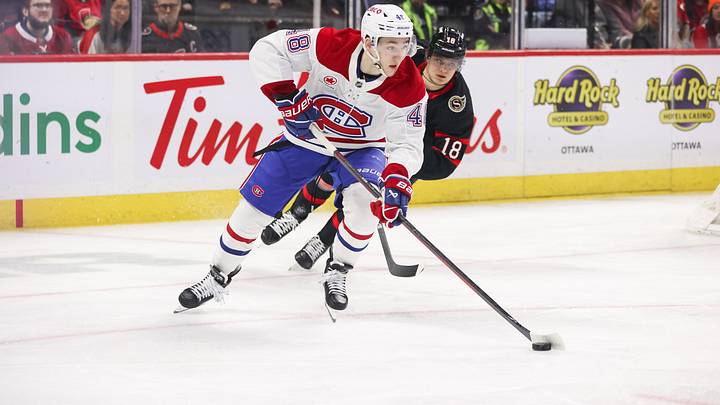
The Atlantic Division was expected to become a ridiculously combative gauntlet this season, and nothing happened during the first quarter of the NHL season to change that outlook.
Teams off to slow starts like the Buffalo Sabres and Toronto Maple Leafs are already behind the eight ball because the Boston Bruins and Ottawa Senators are exceeding preseason expectations while the Florida Panthers, Montreal Canadiens and Tampa Bay Lightning all look like true Stanley Cup contenders.
It creates an environment where there's virtually no margin for error, and it's going to make for some entertaining, high-stakes hockey in pretty much every Atlantic battle between now and mid-April as clubs jockey for position in the Eastern Conference playoff race.
As for the Detroit Red Wings? Well, that's where we'll kick off our divisional power rankings as the United States prepares to celebrate Thanksgiving on Thursday. Our friendly neighbors to the north already gave their yearly thanks in October.
8. Detroit Red Wings
The Dylan Larkin saga is over. That's the good news for Wings fans. The return package, headlined by University of Michigan standout Michael Hage, was probably about as good as the franchise could hope for given the unfortunate circumstances.
Alas, the bad news is now the organization finds itself in a tricky situation with cornerstones Moritz Seider, Lucas Raymond and Alex DeBrincat all signed for the long haul and likely wanting to avoid the immense on-ice suffering that comes with a full-scale NHL rebuild.
Trying to embark on a more modest roster reconstruction while remaining competitive won't be easy given the strength of the Atlantic, which could leave Detroit in no man's land for a bit.
7. Toronto Maple Leafs
Sometimes it's important to simply admit your mistake. Signing 38-year-old Sergei Bobrovsky to a three-year, $21 million contract instantly felt like an unforced error and the initial returns (.874 save percentage in 14 games) suggest those vibes may have been accurate.
To the Leafs' credit, they've now started Anthony Stolarz (.902 SV%) in three straight games. Stolarz has struggled to stay healthy throughout his career but, at least while he's at full strength, there's no doubt he's Toronto's best option between the pipes.
He should receive a lion's share of the starts until Bobrovsky shows signs of turning things around, if that even happens.
6. Buffalo Sabres
The Sabres haven't looked like the club that went on one of the best runs in NHL history last season. A combination of lackluster finishing offensively, mental lapses defensively, poor goaltending and ineffective special teams have led to a forgettable start.
Buffalo has showed some promising signs lately, though. Ukko-Pekka Luukkonen has strung together some better starts and a little bit of secondary scoring has finally started to arrive, taking at least a little burden off the shoulders of Tage Thompson and Jack Quinn.
Now the question is whether the reigning division champions can start playing a more complete brand of hockey on a consistent basis, or whether it'll slide back into its early-season funk.
5. Boston Bruins
Marco Sturm should be the slam-dunk winner of the Jack Adams Award as the NHL's Coach of the Year if the Bruins are able to maintain anything close to their current 113-point pace over the full 84-game schedule. He's doing an outstanding job.
Boston was widely predicated, both by old-school analysts and new-school analytic models, to take a step back this season after making the playoffs last year. That mostly stemmed from a relatively muted summer and the immense strength of the division.
Instead, the B's are seventh in the league in points percentage (.674) and their goal differential (+22) is tied for third with the Colorado Avalanche and Edmonton Oilers.
4. Florida Panthers
A few alarm bells started ringing after the Panthers lost four of their first six games, but they've righted the ship and they should only get more dangerous from here. That's mostly because cornerstone center Aleksander Barkov is nearing his return from injury.
While Florida's high-end talent may give it the highest upside in the Atlantic, goaltending concerns still create real uncertainty. The Cats rank 22nd in team save percentage (.883) and have given up at least four goals in nine of their 11 losses this season.
If neither Jacob Markstrom nor Akira Schmid elevates their level of play before the NHL trade deadline in March, a deal may be necessary to boost the team's championship hopes.
3. Ottawa Senators
You'd have thought the Sens were a sinking ship with how forcefully Brady Tkachuk pushed for his trade to the Panthers. Instead, they're one of the league's most complete teams for a second straight year, sitting atop the division with a 16-6-3 record.
Ottawa is seventh in the NHL in all-situations expected goal share (54%), which is the top mark of any club in the Atlantic, according to HockeyStats.com. It also owns one of the league's best marks on home ice (9-2-2) in the early going.
It'll be interesting to see whether the Senators make a strong push for one more offensively gifted forward over the next few months to bolster an otherwise well-rounded roster.
2. Tampa Bay Lightning
A lot of what happens with the Bolts for the remainder of the season obviously depends on disgruntled superstar Nikita Kucherov. It'd be nearly impossible to get fair-market value for him given the trade request and his status as an impending unrestricted free agent.
For now, it appears Tampa is going to ride out the storm and, at least at the moment, it doesn't appear the two-time Hart Trophy winner wants to sit out games to force the front office's hand. We'll see if that changes as the deadline draws closer in a few months.
The Lightning will remain among the top-tier Cup threats as long as Kucherov sticks on the roster.
1. Montreal Canadiens
The Habs are third in the Atlantic standings and haven't been dominant as of late (5-4-1 record in their last 10 games), but placing them atop the power rankings is about crediting a front office for taking a bold swing when perhaps one wasn't absolutely necessary.
NHL teams are often too hesitant to swing for the fences. Montreal was on pace to cruise toward the playoffs without Larkin. It could have maintained the status quo, added Hage to the lineup next year and just hoped to strike gold with a playoff run in the coming years.
Instead, they filled a pressing need with Larkin sliding in as a high-end No. 2 center. It immediately raises both the Canadiens' floor and ceiling, while affirming the club is solely focused on maximizing its chances to win right now. That's refreshing too see.
 Add us as a preferred source on Google