

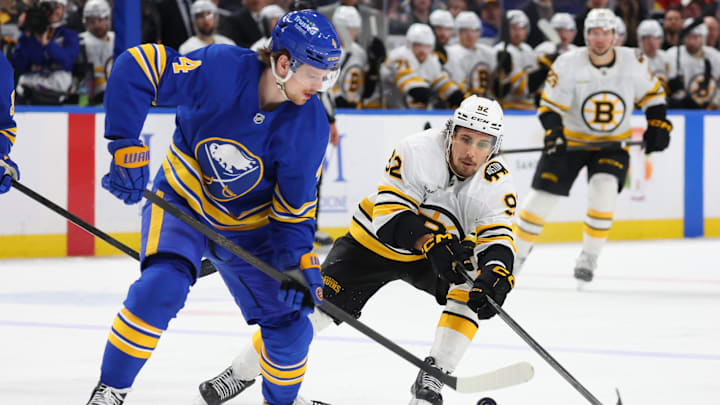
The Buffalo Sabres finished the 2025-26 season as one of the NHL's better home teams.
The team's 26 wins at KeyBank Center consisted of just over half the team's regular-season victories. The Sabres also lost just 10 times in regulation, making up around a quarter of their 41 total home games.
While that home-ice advantage could be critical for the playoffs, that could be offset entirely by a Bruins side that knows how to win in a general sense of the concept. While the Bruins were just 16-16-9 on the road, they won 29 of their 41 home games, three more than the Sabres' number of wins on home ice.
The big question should therefore be whether the Sabres need to prepare for the ultra-dominant road teams of the Bruins' playoff past, or whether this edition of the team is better equipped to win at TD Garden.
Bruins' dominant play at home may be the series' ultimate equalizer, but their postseason past creates questions
The Bruins are seen to have good home form when it comes to the postseason. From the 2012-13 season on, Boston has a 31-29 record on home ice in the playoffs (not including the 2020 bubble playoffs). That run of form includes a 3-0 record at home against the Carolina Hurricanes during their first-round encounter in 2022 and an 8-4 record at TD Garden during their run to the Stanley Cup Final in 2013.
That said, the Bruins seem to be slightly better when playing on the road; over that same timeframe, the Bruins are 29-23 on the road during the playoffs. That ratio includes two wins at the Canadian Tire Centre against a Conference Finals-bound Ottawa Senators team in 2017 and a 7-3 road record during their run to the Cup Final in 2019.
The only difference here is that the Sabres will have a passionate-and-maybe-rowdy fan base backing them during their home games. At the same time, they'll have to put up with a passionate-and-definitely-rowdy Bruins fanbase during their road games at TD Garden (at least Happy Gilmore is fictional, right? Come to think of it, I rest my case).
Adam Sandler references aside, Bruins fans do tend to be incredibly passionate ... and restless. Just look at their wonderfully-polite reaction to this goalie interference call in Game 3 of the Bruins' second-round series against the Florida Panthers in 2014:
TD Garden crowd not happy with the penalty called on Jakub Lauko.
— Belle Fraser (@bellefraser1) May 11, 2024
Water bottles flying onto the ice with “refs you suck” chants. pic.twitter.com/ow9nORWpa9
With this in mind, it is worth noting the counterargument; The Athletic ranked Boston's home arena as only the 18th best among the league's 32 rinks. TD Garden was cited as being a great hockey venue at the best of times, and writers did give the arena a sixth-place score. But the atmosphere and fan aspects were nonetheless ranked just 15th and 22nd respectively.
How do the Sabres maintain control of the first-round matchup?
It's simple: win Game 1 and 2.
From my numerical analysis of the Bruins' past nine postseason trips (not including the pandemic playoffs), there is some similarity between the team's performance at home and on the road. That said, four of the nine postseasons in question demonstrate home and road playoff records that are considerably different from one another (2017, 2022, 2023, and 2024).
In three of those playoff tournaments, the Bruins performed considerably better on the road than at home. The lone exception (2022 vs. Carolina) saw the Bruins go unbeaten at home and winless on the road.
This year's Bruins team does technically fall into that category, meaning that the Sabres should be wary of the home-ice factor regardless of what form it may take.
If the Sabres can convert the first two games of the series into wins, the need to win at home shifts to Boston rather than Buffalo. Winning the remaining games at KeyBank Center would only be half of what Boston would need to advance, and neither of those games would be guaranteed to happen when down 2-0. And even if the Bruins won their three games at TD Garden, all Buffalo would need to do to advance is take care of business on home ice and get to the required four-win threshold.
 Add us as a preferred source on Google