

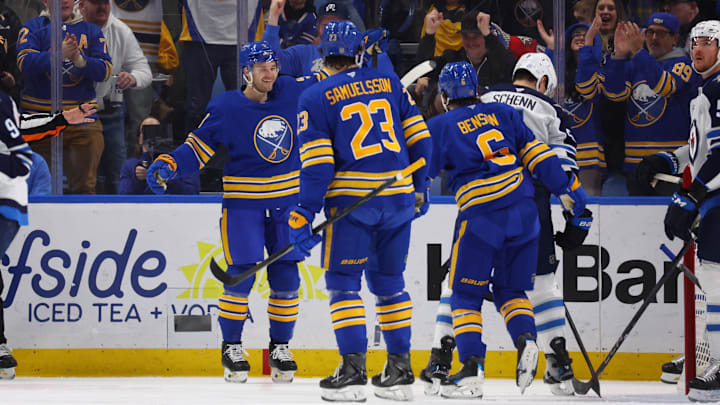
With the NHL Trade Deadline only a few weeks away, almost all options should be on the table for the Buffalo Sabres as they try to earn a playoff spot and end their playoff drought. It is going to be a big test for general manager Jarmo Kekalainen as he not only has to keep an eye on the trade market but also work towards a contract extension for players like Zach Benson and Alex Tuch.
Extensions for those two players are going to be tough with the expected cap space the Sabres are set to have next season. However, one way Kekalainen can make it a little easier is if he can find a team interested in trading for Josh Norris, whom the Sabres acquired at the trade deadline last season from the Ottawa Senators.
According to Puckpedia, the Sabres are currently projected to have around $14 million in cap space. When considering that Alex Tuch is expected to get over $10 million AAV on his next contract and Benson is probably closer to $6 million, it is tough to keep both and add in free agency.
Buffalo Sabres trading Josh Norris creates some much needed cap space to extend key players
However, Josh Norris has a cap hit of $7.95 million and is under contract for four more seasons after this one. If the Sabres are able to move him, it frees up enough cap space to keep both those players with room to make additional moves.
Another reason the Sabres might consider trading Norris now is that after this season, he has a modified no-trade clause that kicks in after this season. If the Sabres want to trade him down the road, it becomes tougher.
There is no question that when Josh Norris has been on the ice, he has made an impact for this team, as he has 17 points in 19 games. However, this also highlights why the Sabres might want to trade him, as he has played in only 19 games this season after only three games with Buffalo after the trade last season.
Norris is expected to be back when the NHL resumes after the Olympic break, having been out with an injury since the middle of January. It won't necessarily be easy for Kekalainen to convince a team to take on that contract for a player who hasn't proven he can stay healthy, but if a trade does materialize, it creates several options for the Sabres' general manager heading into his first trade deadline and then his first offseason in the role.
 Add us as a preferred source on Google