

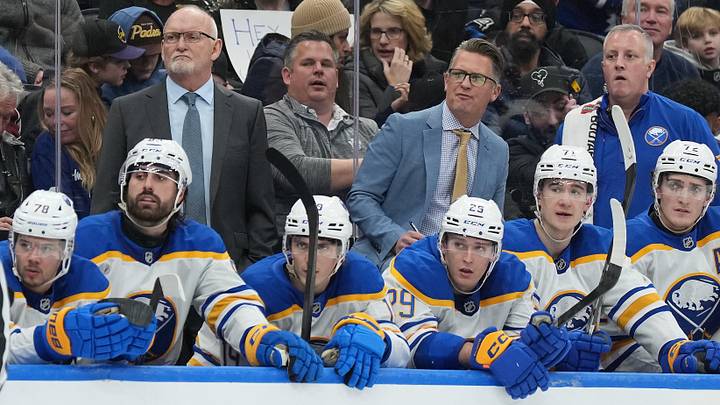
Stop blaming Buffalo Sabres assistant coach Seth Appert for the team's power play failures.
That's the message from Sabres insider Paul Hamilton, who took a strong stance in favor of Appert during an appearance Friday on WGR 550 Radio while laying out the poor performance by Lindy Ruff teams with the man advantage across his stops with the Dallas Stars, New Jersey Devils and now his second stint with the Sabres.
"This isn't Seth Appert, people. I have just been trying to make people understand in the NHL — Yes, Lindy Ruff takes input from Seth Appert and every assistant coach. They sit down in the summertime and decide how they're going to do their special teams. Then Lindy Ruff tells Seth Appert what to coach. And then he tells Marty [Wilford] on the penalty kill what to coach. It is Lindy Ruff's power play. It is Lindy Ruff's penalty kill. It is not — they're screaming in there fire Seth Appert — it is not his power play."WGR's Paul Hamilton
The Sabres' play with the man advantage is once again in the spotlight because the unit is 0 for 13 during the early going of the 2026-27 season. They're the only team without a PP goal.
Appert, as the assistant in charge of that unit, has drawn most of the criticism, but there's no doubt Ruff deserves a fair share of the blame, as do the players. It's a systematic failure across the board.
What's most frustrating through four games of the new campaign, however, is how little has seemingly changed. Fans were hoping for a complete overhaul of the club's 5-on-4 approach, especially after Appert discussed a 50-page report from the analytics department about fixing the issues.
Yet, at least on the surface, it doesn't feel like much has changed. Buffalo is still using the neutral-zone drop pass in an effort to gain entries despite its low success rate, and there's still a frustrating lack of movement in situations where the Blue and Gold do get set up in the offensive zone.
Didn't have time for a 50-page report, but perhaps the Sabres should try to generate some power play shots from the inner slot?#LetsGoBuffalo | @SabreNoise pic.twitter.com/nmm8Y1J9Fd
— Tim Daniels (@ByTimDaniels) October 9, 2026
A typical Sabres power play features a lot of perimeter passing with little net-front traffic followed by a Tage Thompson one-timer or a Rasmus Dahlin wrist shot through traffic. There's no creativity to put pressure on opposing penalty kills.
Ultimately, somebody has to take responsibility for that complete inability to capitalize in key moments, whether it's Ruff, Appert or the players, and actually consider widespread changes to how they operate with the man advantage.
The battle for playoff spots in the Eastern Conference will be intense. It'll be tough for Buffalo to keep pace over the next 80 games if its special teams doesn't vastly improve.
Buffalo Sabres penalty kill also struggling early in 2026-27
The Sabres' strong performance on the penalty kill is one of the main reasons they finally ended their 14-year playoff drought last season. They finished fourth in the NHL on the PK (81.9%). They also scored 11 shorthanded goals, which was tied for second in the league.
That PK magic has been missing early in the new campaign.
Buffalo rates 28th while playing a man down so far (63.6%). The reigning Atlantic Division champions have given up at least one power play goal against in three of their four games.
An adjustment period was expected because four key members of last year's penalty killing units departed the organization in the offseason: Alex Tuch, Jordan Greenway, Bowen Byram and Logan Stanley. Another one, Conor Timmins, has been sidelined by injury.
In turn, Ruff and Wilford have been forced to try out several new tandems, both in terms of the forwards and the defensemen. Josh Norris and Jack Quinn, two offensively focused players, were out there together at one point on the PK, highlighting the lack of early answers.
One question continues to linger: Why isn't Peyton Krebs used on the penalty kill?
The 25-year-old Canadian is a hardworking forward capable of playing either center or wing who's posted strong defensive metrics throughout his time in Western New York. He also received a four-year, $18 million contract extension over the summer, suggesting the team believed he was ready to step into a bigger role in high-pressure situations.
Although he doesn't own a lot of PK experience, giving him some opportunities early in the season to see how he handles the role makes sense. It certainly feels like an area he could provide value.
Look, it's always important not to overreact to a four-game sample size, particularly because it was evident there may some growing pains given the offseason roster changes. The Sabres have continued to post strong underlying 5-on-5 metrics, which is a good sign.
The fact the team's biggest issues are the ones identified by fans before the season — goaltending and special teams (mostly the power play) — has still created instant frustration, though.
 Add us as a preferred source on Google