

The Buffalo Sabres have their first opportunity to secure a berth in the second round of the 2026 Stanley Cup Playoffs with a victory in Game 5 against the Boston Bruins on Tuesday night.
Buffalo, which won 39 of its final 53 games during the regular season, started the postseason a bit sluggish but got back on track by winning the two games in Boston by a combined score of 9-2. It gave the upstart club a 3-1 lead as the series shifts back to the KeyBank Center.
The Sabres have one of the NHL's deepest rosters, which gives them a little more margin for error when their top contributors aren't playing their best hockey. Getting everyone clicking on all cylinders at the same time is when they would enter the championship conversation, though.
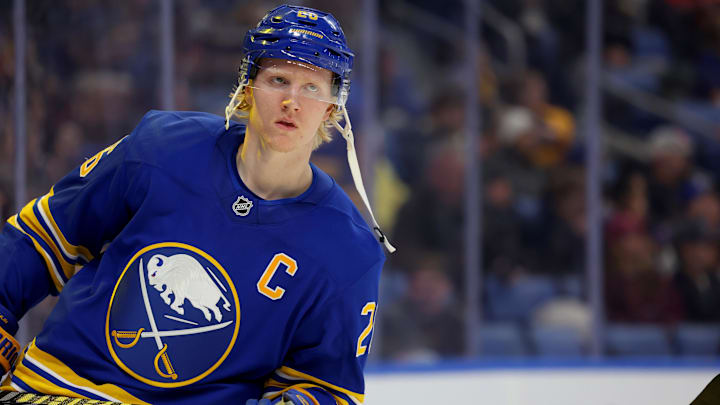
It's a quest that starts with getting more offensive involvement from their captain.
Rasmus Dahlin (Defenseman)
Dahlin hasn't played poorly in the Bruins series. The Sabres are still controlling the 5-on-5 play when he's on the ice — 66.7% expected goal share in those situations, per Natural Stat Trick — but he's yet to make much of a scoring impact (no goals and one assist).
In addition, his lackluster offensive production is impacting Buffalo's struggling power play, which has gone 38 straight attempts without scoring a goal. (Yes, the Blue and Gold did find the net shortly after a man advantage expired in Game 4.)
Dahlin has also taken three penalties in the series and had another infraction that led to a Bruins penalty shot that was stopped by goalie Alex Lyon. An inability to stay out of the penalty box has been a longstanding problem for the All-Star defenseman.
So, there are definite areas in need of improvement, especially when you compare the Norris Trophy candidate's play to the second half of the regular season, when he was one of the NHL's best players. That hasn't been the case so far in the playoffs.
Jason Zucker (Winger)
Sticking with the power-play discussion, the special-teams unit typically finds its stride when Zucker is playing well. He's an important net-front presence who's got good hands around the crease and is capable of creating chaos for opposing goalies with his screens.
Buffalo's power-play struggles rest heavily on assistant coach Seth Appert, who's shown little innovation since taking over the PP planning before last season, but at some point it's up to the players, especially veterans like Zucker, to create some of their own solutions.
The 34-year-old forward has 55 career power-play goals, and 21 of those have come over the past two years since arriving to the Sabres. He also has 16 assists with the man advantage over that span.
Zucker is also capable of making a more consistent impact at even strength — his line with Ryan McLeod and Jack Quinn was one of the league's most dangerous coming out of the Olympic break in February — but his special-teams contributions are more vital in the short term.
Ryan McLeod (Center)
McLeod was one of the Sabres' most dependable players for a vast majority of his first two seasons with the organization. He's suddenly gone quiet since the stretch run of the regular season, though.
The 6-foot-3 centerman scored just five points (two goals and three assists) over the final 14 games of the campaign. That offensive cold streak has carried over to the series against Boston with just one assist and five shots on goal through four contests.
He's also gone 39-41 on faceoffs, a continuation of his underwhelming performance on draws after winning just 47.7% of his nearly 1,300 trips to the dot in 81 games this season. He won a career-high 52.3% of his faceoffs during his first year in Buffalo.
McLeod isn't the type of player who's going to take over a series. Instead, he's usually doing all the little things to help the Sabres win, and that just hasn't been happening as much lately. Getting him back on track would have a strong trickle-down effect for the Atlantic Division champions.
 Add us as a preferred source on Google