

Every Buffalo Sabres story written after Game 1 against the Boston Bruins would have began with the team's horrendous performance on the power play. Then the Blue and Gold stormed back with four goals in the third period to stun the B's, changing the main focus.
Yet, it's still impossible to overlook just how useless Buffalo's play with the man advantage has been lately. It went 0 for 4 in Sunday night's 4-3 comeback victory over the Bruins, which extended a streak of 26 straight power-play opportunities without a goal. That's unacceptable.
It's also not surprising. Back in January, we discussed how Seth Appert, the assistant coach in charge of the power play, should have been on the hot seat given the unit's dreadful results. It was mired in a similar 1-for-21 slump at the time.
The Sabres finished 20th in the NHL with a 19.5% PP conversation rate, which is hard to believe given the club's terrific offensive depth. By comparison, the team ranked fifth in overall goals scored (288) during the regular season. The talent is there.
Appert's power-play playbook yields little confidence a turnaround is coming, though.
Buffalo uses the same, tired neutral-zone drop pass on nearly every entry attempt — the Bruins scouted it well and intercepted one of the passes to create a shorthanded scoring chance on Sunday — and that allows opponents to stack the blue line to easily disrupt the attack.
Even when the Sabres do gain the zone, the lack of movement is astonishing. The players pass the puck around the perimeter with nobody trying to create space or confusion until Tage Thompson or Rasmus Dahlin gets tired of the monotony and fires off a low-danger shot.
The same problems that existed in October still bog down the unit in April. It's been the most frustrating aspect of the team's season, and there really isn't a close second.
Buffalo has a chance to do something special in the playoffs, but the utterly futile power play may destroy those dreams if a solution isn't found in the near future.
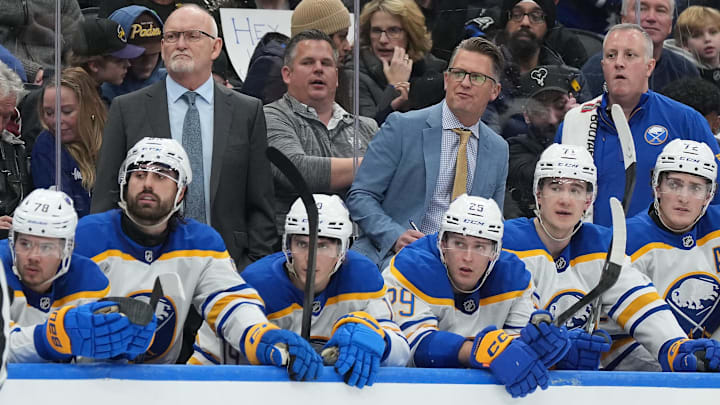
Sabres head coach Lindy Ruff must take on a bigger power-play planning role for the 2026 NHL Playoffs
Ruff is an old-school coach who prefers to oversee the entire coaching operation while delegating responsibility for the power play and the penalty kill to his assistants.
Marty Wilford has done a nice job with the penalty kill this season, but Appert's power play has failed repeatedly, and now it's putting the team's playoff run at risk.
As a result, don't be surprised if Ruff begins implementing a more of a hands-on approach when it comes to the PP game plan. Something needs to change, and so far there's no indication Appert is capable of coming up with the necessary ideas to fix the problem.
It may also become an all-hands-on-deck situation.
Michael Leone, the head coach of the Rochester Americans (Buffalo's AHL affiliate), recently made some noteworthy comments while discussing the Amerks' power-play success (fourth in the AHL at 23.3%) amid the club's other struggles down the stretch.
"I feel personally that we have an NHL power-play coach at the AHL level," Leone told LGA585.com about Vinny Prospal, who played over 1,100 NHL games across 16 seasons.
The Amerks recently clinched a berth in the league's Calder Cup Playoffs, so their coaching staff is busy planning for the Toronto Marlies, but getting some opinions from Prospal about potential ideas and alterations sure sounds like a smart idea.
This likely won't be a situation like an NFL head coach publicly confirming he's taking over play-calling duties from his offensive coordinator, but Ruff has been around the sport long enough to know when change is necessary.
The Sabres need to try something different, whether it's a new zone-entry scheme or some fresh puck-movement designs once zone possession is established, to put pressure on opponents. The Bruins never felt troubled by trying to slow down Buffalo's 5-on-4 approach in Game 1.
Ultimately, the Sabres came away with the victory in the series opener and that's the most important factor at the end of the day. Winning cures all ills.
They aren't a true Stanley Cup threat unless the power play starts making an impact, though.
 Add us as a preferred source on Google