

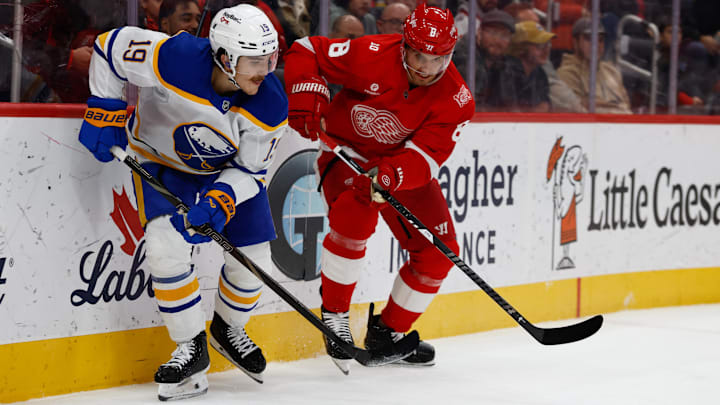
The Buffalo Sabres and Detroit Red Wings appear destined for an intense multiyear battle as the balance of power shifts in the NHL's Atlantic Division, so Sabres general manager Jarmo Kekalainen is probably pleased with Wednesday's news.
Detroit announced it signed defenseman Ben Chiarot to a three-year contract extension that carries a $3.85 million annual salary.
Here's the problem for the Wings: Chiarot already grades out as one of the league's least effective blueliners, and that trend is unlikely to reverse given he's 34 years old.
Dom Luszczyszyn of The Athletic, who estimates the Canadian defender's market value at $800,000, called it a "truly unconscionable extension:"
A truly unconscionable extension. pic.twitter.com/FtqlTMUXTy
— dom 📈 (@domluszczyszyn) January 28, 2026
Jack Fraser, who runs the JFresh Hockey analytics brand, delivered a similar take:
Ben Chiarot, extended 3x$3.9M by DET, is a physical veteran defenceman. Despite having good size, decent mobility, and some puck-carrying ability, his team tends to get completely wrecked when he's on the ice and his partners tend to fare much worse next to him. #LGRW pic.twitter.com/npltmqttg3
— JFresh (@JFreshHockey) January 28, 2026
Based on Luszczyszyn's numbers, the Wings are set pay Chiarot about $9.3 million in excess value over the next three seasons. That's significant, even in a rising-cap environment.
For the Sabres, who are going to face some difficult financial decisions of their own between now and the offseason, having one of their closest rivals make a mistake of that magnitude provides an opportunity to create an edge.
Now it's up to Kekalainen to take advantage of it.
Buffalo Sabres must learn from the Detroit Red Wings' unforced error with Ben Chiarot when it comes to Alex Tuch
Alex Tuch is a far more impactful NHL player than Chiarot, but the size of the monetary mistake could loom even larger if Buffalo opts to give him a long-term contract extension.
Tuch's reported demands have remained constant since the summer. The 29-year-old Syracuse native, who grew up rooting for the Sabres, is seeking an eight-year deal worth around $10.5 million per season.
Is the two-way winger an important piece of Buffalo's roster puzzle? Yes. Is he worth anywhere near that amount of money? Probably not, especially since the contract likely won't age well as he enters his mid- and upper-30s before it ends.
Luszczyszyn pegs Tuch's average market value for the duration of a max-length extension at $7.1 million, and even in the immediate future he's not expected to bring double-digit AAV value.
It creates an incredibly tough situation for Kekalainen.
The 6-foot-4 power forward is a fan favorite who sees the ice in every situation, and his involvement in particularly important on the penalty kill, which is quite the statement for someone who's also scored 110 points in 133 games since the start of last season.
Yet, the Sabres GM must also consider the fact he has two impending restricted free agents in Zach Benson and Michael Kesselring who are important parts of the club's future and will be seeking sizable raises. Peyton Krebs is also an RFA, and Josh Doan just signed a seven-year extension.
So the Blue and Gold simply don't have a ton of cap flexibility like they have in the past, and the Jeff Skinner buyout figure peaks at $6.4 million next season, as well.
The next question becomes should the Sabres trade Tuch if an extension isn't possible?
At minimum, Kekalainen should be surveying the market to see whether there are any "hockey trades" available. If Buffalo can get a younger NHL player under contract beyond this season as the cornerstone piece in a Tuch trade, it should absolutely be considered.
If the only offers include picks and prospects from Stanley Cup contenders, however, it wouldn't make much sense for the Sabres. At that point, it'd be best to consider Tuch an "own rental" and let the chips fall where they may at season's end.
Ultimately, the organization and its fans will hold out hope the on-ice success may get the 2014 first-round pick to at least consider a modest "hometown discount" to remain in Buffalo for the long haul.
If Tuch doesn't move off his $10 million-plus asking price, the Sabres are best off letting him hit the open market while beginning the search for a more cost-effective replacement.
Overpaying aging veterans, as the Wings did with Chiarot, rarely works out well in the long run.
 Add us as a preferred source on Google