

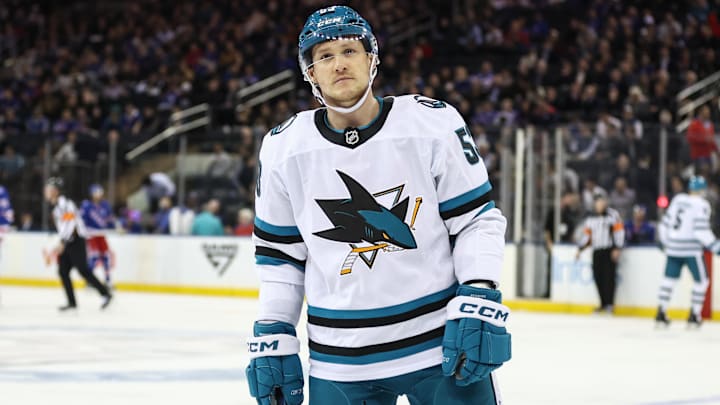
Next season, the Buffalo Sabres must account for a $6.4 million salary-cap hit for winger Jeff Skinner, who hasn't played for the team since 2024. It's the result of a devastating mistake back in 2019, and it's a blunder new general manager Jarmo Kekalainen can't replicate moving forward.
Skinner, whose one-year contract with the San Jose Sharks is in the process of being terminated after the club placed him on waivers Monday, signed a massive eight-year, $72 million extension with the Sabres in 2019. Former GM Jason Botterill inked that deal.
Everyone understood at the time there was a real chance the contract would age terribly and, when the rate of the winger's decline accelerated, Buffalo bought him out. They'll pay the price of that error in judgment through the 2029-30 season.
It's something Kekalainen needs to keep in mind as he nears a final decision about whether to re-sign Alex Tuch before the fan favorite becomes an unrestricted free agent in the offseason.
Tuch will turn 30 in May. Is giving the 6-foot-4 power forward an eight-year extension that'll pay him around $10.5 million annually until his late-30s the right play? Probably not, especially since the Sabres already don't have a ton of financial flexibility.
Losing Alex Tuch for nothing would hurt the Buffalo Sabres but it may be Jarmo Kekalainen's best option
Typically, the mindset for signing an older player to an extended contract extension centers around the short-term value making up for the long-term concerns. That doesn't really work in Tuch's case.
Giving the Syracuse native his desired salary, which has remained steady at a bit over $10 million since the summer, has very little chance of netting positive value, even in the immediate future.
Last month, Dom Luszczyszyn of The Athletic estimated Tuch will only provide about $8.3 million in value next season and that'll dip to around $5 million during the course of a potential extension. The winger's averaged expected value sits at $7.1 million..
So, on an eight-year contract, Tuch is asking for around $84 million but is only projected to deliver around $56.8 million in on-ice contributions. That's a $27.2 million net loss.
The Sabres also don't want to find themselves in another Skinner situation where they have to buy Tuch out with multiple years remaining and significantly impact their future cap outlook.
In turn, there simply isn't a wise path forward in terms of an extension unless the 2014 first-round draft pick substantially reduces his asking price between now and the summer.
Typically those situations result in the team trading the player to recoup some assets, but that's also not the best path forward for Buffalo right now.
The Sabres are making a serious bid to make their first postseason appearance since 2011 to end the longest playoff drought in NHL history at 14 years. They sit in the Eastern Conference's top wild-card position as the league breaks for the 2026 Winter Olympics.
Tuch is an important part of that success. He's scored 48 points (22 goals and 26 assists) in 56 games, and he sees ample ice time in all three phases. His impact is crucial on the penalty kill, where he's paired with Ryan McLeod to form one of the NHL's best PK forward tandems.
As a result, trading him for some futures, whether it's prospects or picks, wouldn't send the right message to neither locker room nor the fanbase.
Kekalainen doesn't want to sacrifice the Sabres' playoff push by trading Tuch and he shouldn't paint himself into a financial corner by meet the star's contract demands. It leaves keeping him as an "own rental" as the best option as things currently stand.
Let Tuch hit free agency and perhaps, if his market isn't as strong as expected and Buffalo is able to make some money-clearing moves, a reunion will be possible at a more reasonable price point.
All told, as the Sabres try to manage a tricky cap situation in the coming months, the Skinner mistake will loom large and can't be repeated despite everyone's fondness of Tuch.
 Add us as a preferred source on Google