

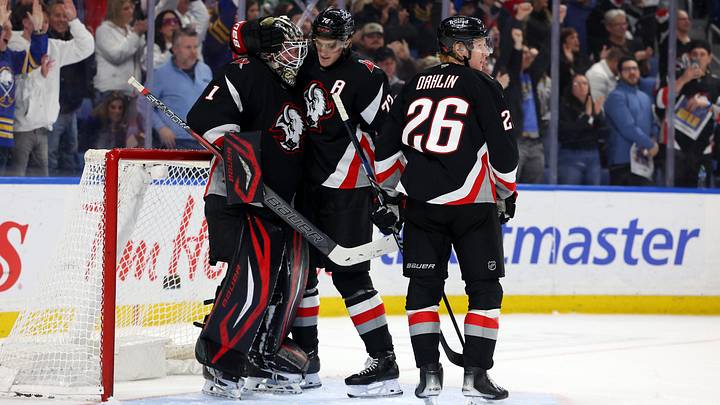
The Buffalo Sabres finally ended a 14-year playoff drought, the longest such streak in league history, last season and the organization's future looks bright thanks to a large cache of young talent, both at the NHL level and within the franchise's prospect pool.
Yet, sandwiched between last season's fond memories and potential Stanley Cup contention in the future is the 2026-27 campaign, which features ample uncertainty after the high-profile departures of Alex Tuch and Bowen Byram, two key members of the 2025-26 roster.
Sabres general manager Jarmo Kekalainen has so far opted against any superstar additions to help offset those losses. Veteran winger Conor Sheary was the only notable signing up front, and he may begin the year in the AHL, while Olen Zellweger and Louis Crevier were acquired for the blue line, though both still have a lot to prove in the NHL.
Scott Maxwell of Daily Faceoff questioned whether it could lead to a troublesome drop off for Buffalo amid significant competition in the Eastern Conference for the upcoming season.
"While I think the 2025-26 Sabres overperformed, I still think this is a very good team," Maxwell wrote Friday. "With most of their key players under the age of 30, they're poised to contend for the playoffs for years to come, especially with the monkey off their back and some playoff experience under their belt. I do think the combination of regression and the losses to their roster will mean they aren't the front-runners for the division title again, but they should still contend for a playoff spot.
"Then again, the Atlantic Division looks quite strong this year, so unless at least two of the five or six other playoff contenders in the division underperform expectations, the Sabres may still be in a tough spot, even if they perform as expected."
The East does look like a gauntlet on paper, both due to high number of Cup threats and the low amount of clubs in true rebuilding mode. It's going to decrease the margin for error across the board. A few untimely injuries could sink pretty much any team in the conference.
As for Buffalo, Tuch and Byram combined to post 108 points (44 goals and 64 assists) last season, which is a lot of production to replace without any elite acquisitions via trade or free agency.
The Sabres will instead hope for improvement from the likes of defenders Zellweger and Owen Power as well as young forwards like Zach Benson, Josh Doan, Jack Quinn, Noah Ostlund, Jiri Kulich and Konsta Helenius to replace those numbers in the aggregate.
Are there risks involved? Of course. Nevertheless, it was probably the right path to take for Kekalainen, who's now maintained future salary-cap flexibility rather than committing $23 million a season to Tuch and Byram, who received over-market contracts from the Washington Capitals and Chicago Blackhawks, respectively.
It puts the Sabres in a promising position to build toward sustainable success over the next decade, even if there's more downside risk when it comes to 2026-27 specifically.
Jarmo Kekalainen must be prepared to act if the Sabres struggle early in the new season
Although there's still a chance Kekalainen makes a blockbuster move before the new season gets underway — Buffalo opens Oct. 1 with road game against the Columbus Blue Jackets — the odds of that happening decrease with each passing day.
Most likely, the Sabres will move forward with their current roster and then adjust of the fly.
The strength of the East and the Atlantic means Kekalainen must be on high alert, though. Last season, the club sat at the bottom of the conference standings in early December after an 11-14-4 start but still managed to surge back to claim the division title.
Buffalo can't expect a repeat of that outcome. If it starts slow, the team's general manager may need to act earlier than usual in search of a spark. Waiting until early March for the trade deadline probably won't be possible with so much competition for the eight playoff berths.
The Sabres do have ample talent within their farm system, so the resources are there for an earlier-than-usual marquee trade, if necessary.
In the bigger picture, the outlook will improve markedly if Buffalo is ample to thread the needle of still making the playoffs this season without substantially impacting their future.
The front office is in a favorable position due to the franchise's young group of players, many of whom are signed to team-friendly long-term contracts, and a cap picture that starts to open up next summer, when the club is projected to have $36.7 million in space, per PuckPedia.
Yes, the Sabres still have some obvious needs, none more glaring than a true No. 1 center. Filling that void, which would allow Tage Thompson to operate on the wing full time, is the singular addition that could bring the team's forward lines perfectly together.
Buffalo may also need a new starting goalie, though Ukko-Pekka Luukkonen still has a chance to solidify that role with a strong year, and defensive depth behind Power, Rasmus Dahlin and Mattias Samuelsson depends on the development of players like Zellweger and prospect Daxon Rudolph, the No. 4 overall pick in the 2026 NHL Draft.
In short, the Sabres are steadily moving toward Cup contention. Most of the pieces are in place, but there are still some key questions to answer over the next 12-to-24 months.
It puts a lot of pressure on Kekalainen's shoulders to juggle those long-term goals without losing sight of what it takes to remain competitive in 2026-27.
 Add us as a preferred source on Google