

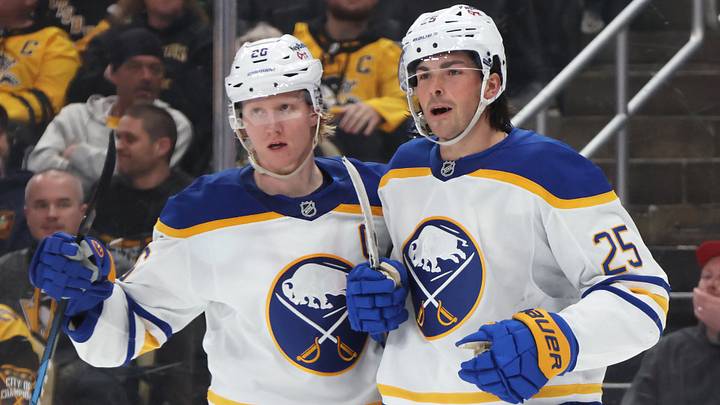
It took far longer than anyone expected — even former general manager Darcy Regier couldn't have anticipated a 14-year playoff drought when he declared the franchise's rebuild "may require some suffering" in 2013 — but the Buffalo Sabres are finally back on the right track.
The Sabres returned to the NHL's Stanley Cup Playoffs last season, ultimately reaching the second round before losing a Game 7 heartbreaker to the Montreal Canadiens. They finished the regular season with the league's fourth-best record (50-23-9).
It's led to far more optimistic projections about Buffalo's future. That continued Wednesday when Paul Pidutti of Daily Faceoff ranked the Blue and Gold at No. 7 in his annual NHL 2030 power rankings, a significant jump from last year's placement (No. 22).
"Does this team have Cup-winning upside? That's to be determined," Pidutti wrote. "But what is clear: it's Go Time in Buffalo. The 15-spot leap is the largest from last season."
Although the Sabres still have questions to answer in order to bring a championship parade to downtown Buffalo — Can they find a high-end No. 1 center? Is their solution between the pipes currently in the organization? — the overall outlook has improved exponentially since they went on the best runs in NHL history starting last December.
Now the pressure is on general manager Jarmo Kekalainen to find those missing pieces while maintaining the financial flexibility to eventually re-sign the Sabres' next wave of young stars, which includes Konsta Helenius, Jiri Kulich, Noah Ostlund and Daxon Rudolph, among others.
Buffalo must also account for the immense strength of the Atlantic Division, and the Eastern Conference as a whole, which is going to make for a fierce battle for playoff spots. Finding a way to keep its contention window open as long as possible is paramount.
That's likely part of the reason why Kekalainen opted to keep both of his first-round picks in the 2026 NHL Draft, which were used to select Rudolph and Ilia Morozov, rather than using those selections as trade bait for potential win-now moves. The goal is sustained winning for the foreseeable future.
Long-term potential outweighs Buffalo Sabres' short-term concerns
The Sabres opted to trade Alex Tuch and Bowen Byram this summer after it became clear neither player was going to sign a long-term contract extension in Western New York.
Kekalainen could have pushed the panic button, opting to overspend on the NHL trade or free-agent markets to find potential replacements. It would have satisfied concerned fans, but it would have likely cost Buffalo some top prospects and much of its newfound salary-cap flexibility.
Instead, the Sabres only brought in a couple new additions, defensemen Olen Zellweger and Louis Crevier, and will otherwise be leaning heavily on improvement from their young players. That's especially true up front, where the organization will be betting on the likes of Helenius, Kulich, Ostlund, Zach Benson and Josh Doan to take their games to a new level.
It's not guaranteed the Blue and Gold won't suffer at least a modest drop off from their 109 points last season. As rosters currently stand, HockeyStats.com projects them to finish third in the Atlantic with 95 points as part of a tight race in the East. That's a fair assessment until we see whether that large cache of rising stars can elevate their play in key roles.
Yet, even if the Sabres take a slight step back toward the playoff fringe in 2026-27, the future will remain bright.
Buffalo has a lot of talent, both at the NHL level and within its prospect pool, and its financial freedom will improve starting next summer with $36.7 million in projected cap space, per PuckPedia.
So, while Kekalainen has started to receive some criticism for his lack of a marquee addition this offseason, he's kept the Sabres in a strong position. How aggressive he'll need to become leading up to the 2027 NHL trade deadline and beyond will depend on the first few months of the campaign.
He's avoided the temptation to flip the switch from playoff team to top-tier Stanley Cup contender too quickly, a decision that often comes back to haunt a franchise. A more measured approach is usually the best way to keep an organization moving in a promising direction for the long haul.
All told, the Sabres are facing ample uncertainty with less than a month before training camp, but the ebbs and flows of the upcoming campaign shouldn't alter the team's future outlook.
Buffalo should eventually emerge as a clear Cup threat, perhaps as early as 2027 but certainly at some point before 2030, and then it all comes down to finding a way to secure the franchise's first title since arriving to the NHL in 1970.
 Add us as a preferred source on Google