

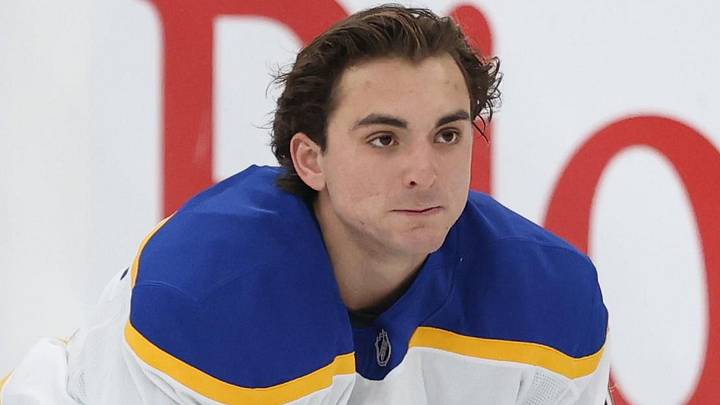
Michael Kesselring and the Buffalo Sabres seemed like a match made in heaven when he arrived to Western New York as part of the blockbuster JJ Peterka trade with the Utah Mammoth last June. One year later, his tenure with the Blue and Gold is already over.
The Sabres traded Kesselring, a 6-foot-5 right-shot defenseman, and the No. 27 overall pick in the 2026 NHL Draft to the San Jose Sharks on Wednesday in exchange for the No. 20 selection in this year's draft, which is taking place at the KeyBank Center in downtown Buffalo.
While many people view it as a light return for the Sabres, Pierre LeBrun of The Athletic detailed why general manager Jarmo Kekalainen decided to move forward with the trade now, with the blueliner set to become a restricted free agent on July 1.
"Per league sources, Kesselring asked for a change of scenery out of Buffalo after a tough year battling knee and ankle injuries and never moving up the lineup," LeBrun wrote Thursday. "He appeared in only one playoff game. Which is why I get the move from Buffalo's perspective, as well — especially when one considers that Kesselring is a restricted free agent with arbitration rights. He could have gotten a one-year deal in arbitration and bridged himself to UFA next year, in which case Buffalo would no longer have had a tradeable asset."
Based on which trade-value chart is used, moving up those seven spots in Round 1 is equivalent to a late-second or early-third round pick, That's probably fair-market value for Kesselring based on his disappointing 2025-26 campaign.
The 26-year-old Northeastern University product recorded zero goals and two assists across 34 appearances with the Sabres. The injuries hampered his skating ability and he struggled to acclimate himself to a more defensive-focused third-pair role.
As a result, Buffalo head coach Lindy Ruff felt more comfortable with the likes of Logan Stanley, Conor Timmins, Luke Schenn and Zach Metsa to play on the bottom pair during the stretch run of the regular season and into the club's first playoff appearance since 2011.
So the Sabres, who are facing a bit of a salary-cap crunch this summer, decided to move on from Kesselring rather than give him a new short-term contract to fill a depth role.
It's an exciting buy-low opportunity for the Sharks, whose front office is led by former Sabres winger Mike Grier. They entered the offseason needing to improve on the blue line, and Kesselring has a strong chance to bounce back if he can get fully healthy over the summer.
Ultimately, it was a situation where both sides benefited from going their separate ways.
A breakthrough season from Mattias Samuelsson changed the Buffalo Sabres' defensive equation
The Sabres spent the fast few years trying to find a long-term partner for Owen Power on the second pair. Kesselring was initially viewed as the long-awaited solution after a strong season with Utah in 2024-25, which saw him post 29 points (seven goals and 22 assists) in 82 games.
As Kesselring, who suffered the first of his multiple injuries in training camp, struggled out of the gate, Mattias Samuelsson was emerging as the two-way force Buffalo always hoped he'd become.
Samuelsson faced heavy criticism coming into the campaign because of his lackluster production, unwillingness to stick up for teammates and injury-prone history. In the blink of an eye, he suddenly start playing like one of the NHL's most complete defensemen.
The 26-year-old Philadelphia native racked up 41 points (13 goals and 28 assists), which is 27 more than his previous career-high total (14), and his plus-41 rating was tied for the seventh-best mark in the league. It was an incredible transformation.
It also left Kesselring and the Sabres in a tricky spot.
Buffalo's brass, headlined by Kekalainen (who took over the GM chair in December) and Ruff, have a strong preference for defense-first blueliners on the third pair. They want players who are going to defend the top of the crease and make simple passes.
Kesselring doesn't view himself as a limited bottom-pair player, though. He wants to become a puck-moving, top-four defenseman. So, when he was given opportunities to play, he tried doing too much, which Ruff hinted at back in February.
"Play well defensively and make a good first pass," Ruff told reporters at the time. "I think he's really trying to push the game in a sense where up ice where probably not the greatest time to be going. But just trying to make stuff happen instead of just let it happen."
Kesselring never appeared comfortable playing that more simple, direct style. He wants to join the rush and make an impact offensively, which didn't match what Buffalo wanted from that role.
So, with Samuelsson, Rasmus Dahlin, Owen Power and Bowen Byram locked into those top-four roles, there just wasn't a perfect spot for the newly minted Shark.
If Samuelsson didn't put together that breakout season, Kesselring probably would have received a few more chances to earn a spot next to Power (or Dahlin). That's just not how the year played out, and it's not a surprise the former Mammoth standout wanted to move on as a result.
He'll get a new opportunity to establish himself in a more meaningful role in San Jose. Doing so would potentially make him a highly coveted unrestricted free agent next summer, unless he immediately signs a longer extension with the Sharks,
On the flip side, the Sabres will need to find more competition for Timmins and Metsa on the third pair before the 2026-27 campaign gets underway in September.
 Add us as a preferred source on Google