

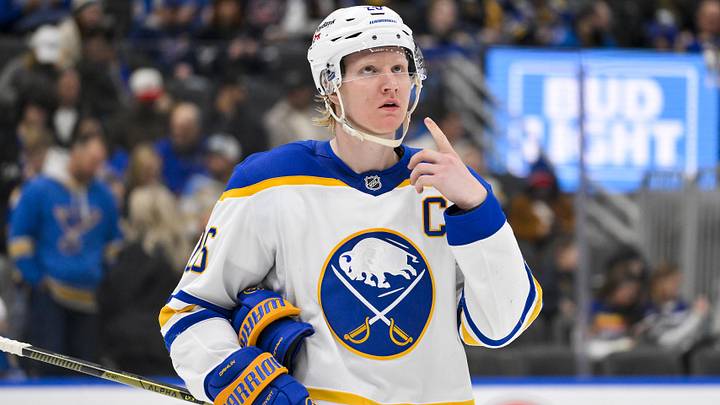
Buffalo Sabres general manager Jarmo Kekalainen is facing a lot of pressure this summer. He's tasked with trying to upgrade a roster that helped the franchise end its 14-year playoff drought despite having limited financial flexibility to make it happen.
Until the Sabres' first notable move of the offseason, the number you'll see most often is $11.9 million, which is PuckPedia's current projection for the club's available salary-cap space. The actual number is a little lower, but we'll get into that shortly.
A major reason for the short-term cap crunch is the $6.4 million dead-cap hit from the 2024 Jeff Skinner buyout. Skinner will remain on Buffalo's books through 2029-30, though the number will drop to a more palatable $2.4 million for the final three years.
It could put the Sabres in a situation where only modest changes are possible over the next few months, with a greater opportunity to make some all-in moves during the 2027 offseason.
Add a No. 7 defenseman to the roster
The $11.9 million figure is based on a roster with 13 forwards, six defensemen and three goaltenders. The Sabres' brass have confirmed they'll likely maintain a three-goalie rotation next season, but that roster formation is still one blueliner short.
For the sake of simplicity, we'll count Ryan Johnson ($875,000 salary) as Buffalo's reserve defender, which brings the real cap space down to the $11 million range.
Re-sign Zach Benson
The Sabres re-signed Josh Doan to a seven-year, $48.65 million contract extension ($6.95 million AAV) in January. They should be doing everything in their power to retain Benson, who's set to become a restricted free agent on July 1, on a similar long-term deal.
AFP Analytics projects Benson to receive a $6.98 million AAV on a seven-year agreement. While that feels a bit light, especially considering his terrific play during Buffalo's playoff run, we'll call it an even $7 million, bringing the estimated cap space down to $4 million.
How about Alex Tuch and Beck Malenstyn?
Quite simply, it's hard to see Tuch fitting in the financial equation. His reported asking price has remained steady around $10.5 million since last summer and, given the NHL's weak UFA class this year, a bidding war could push his salary toward (or above) $11 million annually.
The Syracuse native was a major part of the Sabres' long-awaited turnaround but it's unlikely that type of lucrative contract will age well into his mid- and upper-30s.
Meanwhile, Buffalo would love to keep Malenstyn, another impending UFA, who's served as a key piece of the club's fourth line and second penalty-killing unit over the past few years.
His contract AAV is projected at $2.64 million (via AFP Analytics), and likely only makes sense if the Sabres are able to move the contract of another fourth-liner, Jordan Greenway ($4 million AAV).
Peyton Krebs and Michael Kesselring uncertainty
Buffalo's list of fourth-line options is overcrowded. Krebs is joined by Greenway, Sam Carrick, Justin Danforth, Tyson Kozak and, if re-signed, Malenstyn. That's five (or six) players competing for four spots, counting the club's reserve forward role.
It could make Krebs, who's set to become a restricted free agent, a trade candidate this summer.
The same is true for Kesselring, another RFA. His first year with the Sabres failed to live up to expectations as he battled several injuries, including a high-ankle sprain, and never looked like the type of impact defenseman Buffalo thought it was getting in the JJ Peterka trade.
Krebs and Kesselring would probably cost around a combined $6.5 million to re-sign, which Buffalo couldn't afford barring other moves to create space. Trading them for prospects or draft picks is one of the alternatives that may be considered.
Salary-reducing trades will likely be required
If the Sabres are going to make a franchise-altering trade this summer — a blockbuster deal for St. Louis Blues center Robert Thomas is the dream, though it sounds like the Blues aren't looking to move him — they'll need to create space or offset the incoming salaries.
Along with Greenway's bloated $4 million contract, other players who may land on the trade block for financial reasons include Josh Norris ($7.95 million), Bowen Byram ($6.25 million), Ukko-Pekka Luukkonen ($4.75 million), Jason Zucker ($4.75 million) and Jack Quinn ($3.38 million).
There are obviously secondary considerations in those cases — Is Byram willing to re-sign? Is Buffalo comfortable moving forward with Alex Lyon, Colten Ellis and Devon Levi if UPL is deal? Etc. — but there are a lot potential savings if a few of those players are moved.
Buyouts are another possible solution to consider, though the lingering problems stemming from Skinner's departure represent a cautionary tale.
Maintaining future financial wiggle room
The Sabres have a lot of young talent heading toward new contracts in the next few years. Along with key pieces like Benson and perhaps Byram, the list also includes Quinn, Noah Ostlund, Konsta Helenius and Jiri Kulich, among others.
Trying to keep some cap space available for those emerging core pieces is essential, and it's another reason why locking up Tuch on a double-digit AAV extension until he's 38 would come with ample risk. Any short-term benefit would likely be substantially outweighed by the long-term issues.
All told, while the Sabres are facing some problematic cap constraints this summer, the future outlook is promising if they focus their spending on rising stars rather than declining veterans.
 Add us as a preferred source on Google