

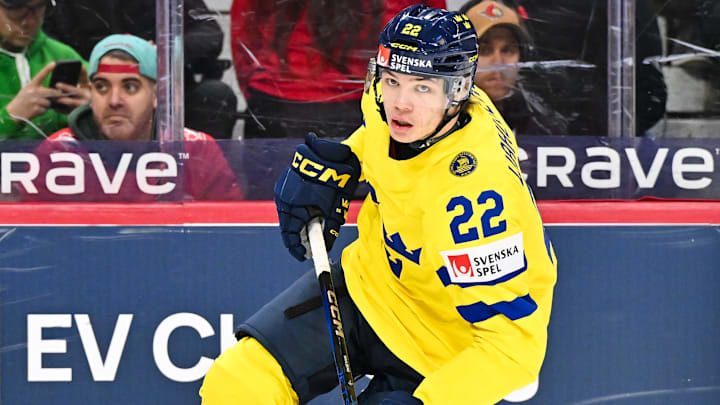
The Buffalo Sabres head toward the 2026 NHL trade deadline as unquestioned buyers for the first time in more than a decade, and that means general manager Jarmo Kekalainen must be willing to part with prospects and draft picks to upgrade the current roster.
Anton Wahlberg, a Sabres second-round pick in the 2023 draft, is a name to watch as his development has slowed as a member of the AHL's Rochester Americans.
Wahlberg has recorded just 18 points (four goals and 14 assists) across 38 appearances for the Amerks this season. That equates to 0.47 points per game in his second full AHL campaign, which is actually a slight decrease from 2024-25 (0.48 PPG).
The 20-year-old Sweden native has remained a reliable presence defensively, which Rochester head coach Michael Leone recently pointed out when asked about the forward's production.
"Asking him … to play the center position in the American League level and playing 1C right now is really difficult," Leone told Tyler Millen of Sabres.com. "There's hard matchups, but he's got a really good defensive stick. He can kill plays when he's playing physical. That's when he's at his best. He has the ability to impact the game without getting points."
Whether that specific skill set fits in the Sabres' long-term plans is unclear, though.
Anton Wahlberg could become expendable in NHL trade talks as Buffalo Sabres target playoff berth
Wahlberg was never projected to come a high-scoring, first-line cornerstone when the Sabres selected him three years ago. Instead, the hope was the 6-foot-3 center would eventually become a two-way, middle-six force for the Blue and Gold.
Now, his limited growth offensively is starting to raise questions about his maximum potential.
It's starting to feel more like Wahlberg may cap out as a third-line center, and Buffalo already has one of the NHL's best players in that specific role in Ryan McLeod.
The Swede, who emerged as a promising young player while quickly climbing the Malmo Redhawks' junior ranks in his home country, could also shift to the wing, but he's still fallen behind the likes of Konsta Helenius, Noah Ostlund and Isak Rosen among Sabres prospects.
That's not to say Wahlberg doesn't have value, of course. He's still a former top-40 draft pick who could still become a productive second-line center if his offense eventually takes a jump. At minimum, he should still become a useful defensive-minded NHLer in the future.
There just isn't a ton of space in that regard on Buffalo's organizational depth chart, however, especially if the front office decides to re-sign impending restricted free agent Peyton Krebs, whose own offensive struggles led him to become a high-energy, fourth-line asset.
In addition, the Sabres are going to have to put prospects of value on the table if they want to make legitimately impactful additions ahead of the deadline. Wahlberg is a player with plenty of runway left to improve which, when paired with his size and strong defensive abilities, creates some intrigue.
Kekalainen shouldn't merely give him away. Trading the Swedish pivot for a one-year rental depth defenseman, which is one of Buffalo's needs, wouldn't make sense. But if he can be part of a larger deal for an offensive-minded, top-six winger, it's at least worth considering put him on the block.
It's time for the Sabres to make a serious postseason push, and sometimes the cost of that quest is giving up a highly touted prospect or two.
 Add us as a preferred source on Google