

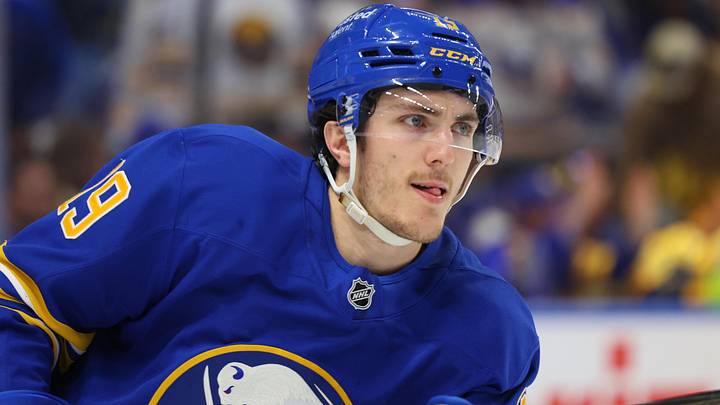
Buffalo Sabres center Peyton Krebs is set to become a restricted free agent on July 1 and he'll likely be looking to cash in after posting a career-high 39 points in 2025-26.
The club's front office, led by general manager Jarmo Kekalainen, shouldn't be rushing to offer the 25-year-old Canadian a significant pay raise, though.
Krebs benefited greatly from spending a significant amount of time in the Sabres' top-six forward group because of injuries. That includes an extended stretch playing on the first line alongside Tage Thompson and Alex Tuch, another impending free agent (UFA).
Therein lies the problem. Paying the 2019 first-round pick, who arrived to Buffalo in 2021 as part of the blockbuster Jack Eichel trade, based on his production this season doesn't make a ton of sense because he's more suited for a fourth-line role on a Stanley Cup contender.
Krebs' offensive weaknesses showed through in the second round of the 2026 NHL Playoffs, as he failed to record a point across seven games as the Sabres were eliminated by the Montreal Canadiens, a series that saw him demoted back to the bottom line.
The high-energy forward does bring value as a team-first, defensively proficient contributor, which allowed him to earn the trust of head coach Lindy Ruff. He doesn't have the offensive skill set to emerge as a true franchise cornerstone, though. He's a replaceable depth player.
So, with Buffalo facing a tight salary-cap outlook this summer, getting Krebs re-signed should be pretty low on the priority list, particularly if he's seeking a substantial pay raise from the $1.45 million he earned this season for the Blue and Gold.
Buffalo Sabres should target a short-term contract extension with restricted free agent Peyton Krebs
Krebs has two years left before he'll first be eligible for unrestricted free agency in 2028. It leaves Buffalo with a few different options.
First, the Sabres could sign him to a one-year extension, which would likely be the cheapest available alternative and keep him as an RFA next summer. It'd also give Kekalainen and Co. another year of data to help determine whether they should view him as a must-keep player moving forward.
Second, Buffalo has the option to sign Krebs to a two-year contract, which would eliminate the need for another round of RFA conversations next offseason. Teams typically avoid this route because it provides the player a direct path to UFA status.
Finally, the Sabres could ink the former WHL standout to longer-term extension with hope he can continue an upward trajectory, even if he slides back into a smaller role in 2026-27 and beyond. This is the riskiest option because it'd come with a higher price tag.
AFP Analytics projected Krebs to receive a three-year, $10.6 million extension this offseason. The resulting $3.55 million salary would represent a sizable $2.1 million increase while buying out only one UFA year in the process.
Is that the worst contract in a vacuum? No. But Kekalainen finds himself strapped for cash as he attempts to solidify the franchise as a contender after finally breaking a 14-year playoff drought.
The Sabres have just $12.9 million in cap space to work with entering the summer, according to PuckPedia. Kekalainen has expressed interest in signing Zach Benson and Bowen Byram to long-term extensions, neither of which will be cheap. (Byram's new deal would kick in for 2027-28.)
Then there's Tuch. Although both sides have suggested an extension is possible, all reports suggest they remain apart in negotiations with just over a month before the winger can hit the open market. His asking price, estimated at around $10.5 million per season, seems a bit rich for Buffalo.
Keeping Tuch would make the financial equation more difficult, but even without him the Sabres have to remain aware of the cap implications of every contract because Noah Ostlund, Jiri Kulich and Konsta Helenius are just some of the young players who will need new deals in the coming years.
Buffalo should also be in the market for a top-six forward via trade in the coming months (the St. Louis Blues' Robert Thomas?), in large part so forcing Krebs up the lineup isn't so common moving forward.
As a result, the Sabres shouldn't be too aggressive trying to lock down Krebs unless he's willing to take a contract below the projected market rate. If they have to handle his situation on a year-to-year basis in order to keep costs down, so be it.
He's a valuable fourth-liner but he shouldn't be anything more than that on a true championship hopeful, and there's a limit on how much teams should realistically pay those type of players.
 Add us as a preferred source on Google