

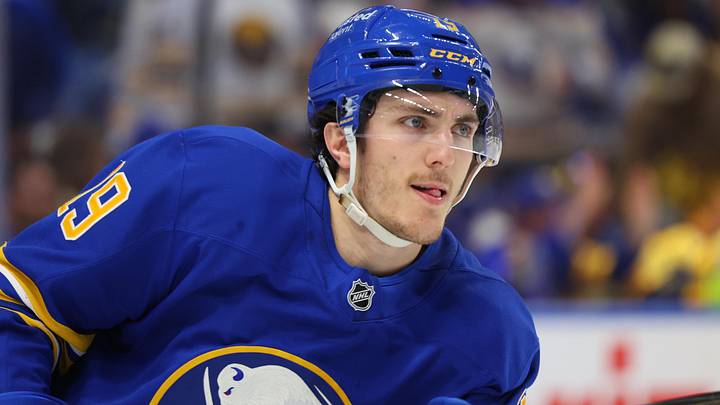
Peyton Krebs was one of the Buffalo Sabres' unsung heroes throughout the 2025-26 NHL season. He was asked to fill a variety of roles, ranging from the first line to the fourth line, and his compete level allowed him to make a positive impact most nights.
Krebs' campaign ended on a low note, as he failed to record a single point across seven outings against the Montreal Canadiens in the second round of the Stanley Cup Playoffs, but it was still a year of promising development en route to a career-high 39 points.
Now the question is what the future holds for the impending restricted free agent, who could seek a decent pay raise from his $1.45 million salary this season.
For his part, the Canadian forward is hoping to remain with the Sabres, who will be forced to make some tough decisions this summer because of limited salary-cap space.
"My daughter was born here. I got engaged here. This is definitely a home for my family and I, and I'd love to be a part of this team as long as I can," Krebs told reporters Wednesday. "Obviously, the group of guys here are unbelievable and a lot of fun to be around. I think that's the biggest thing: Is it a fun environment to come to the rink? And that it is, for sure. I got to know my neighbors really well, and all the people out in Clarence where I live. It's definitely something I'm looking forward to, and I want to bring a Stanley Cup here."
Although there's a high probability Krebs returns, likely on a short-term agreement — a two-year contract would allow him to become an unrestricted free agent when first eligible in 2028 — it's not a 100% lock because of Buffalo's financial situation.
The Sabres are projected to have just $12.9 million in cap space entering the offseason, according to PuckPedia. They have eight other free agents to make decisions on, a group led by star winger Alex Tuch, who'd eat up a vast majority of that money if re-signed.
So, it's possible Krebs could become a trade candidate depending on the front office's other moves, but it's far more likely he's still donning the Blue and Gold to open next season.
Peyton Krebs' lineup spot to open next season's training camp will be a key bellwether of the Buffalo Sabres' offseason success
Krebs is a team-first player who's willing to take on any responsibility, and those type of contributors are a valuable resource to any NHL organization.
His offensive skill set is extremely limited, though. He owns a below-average shot, he misses the net far too often, his awareness in the attacking zone is subpar and the playmaking skills that made him a first-round draft prospect have never fully translated to pro hockey.
In other words, a franchise hoping to emerge as a legitimate Stanley Cup contender can't have Krebs playing first-line minutes, even in times of injury crisis. But that's where the Sabres found themselves during the stretch run of the regular season and the early stages of the playoffs.
The house of cards collapsed in Round 2 against the Habs as both Krebs and Tuch went scoreless, which was a serious problem in a series that was ultimately decided by a Game 7 overtime goal.
In turn, the Sabres' first lines of training camp in September will tell an important story about whether general manager Jarmo Kekalainen had a successful summer.
Krebs should be on the fourth line and, when injuries arise throughout the 2026-27 campaign, he should never climb higher on the lineup card than the third line. He simply doesn't have the offensive skill set necessary to play a scoring role for a top-tier team.
That doesn't mean he can't bring value, both on the ice and in the locker room, but it's just the reality of what type of player he's developed into at this stage of his career.
Building a roster that's able to withstand some injuries without forcing Krebs into the top six, which has been the most common decision in those situations over the past few years, would be a clear sign of progress as Buffalo attempts to join the league's elite.
Meanwhile, the center's two main summer focuses should be working on his shot and becoming more efficient in the faceoff circle after winning just 44% of his draws this season.
Doing those things would make him an even more useful bottom-six asset for the Sabres in 2026-27.
 Add us as a preferred source on Google