

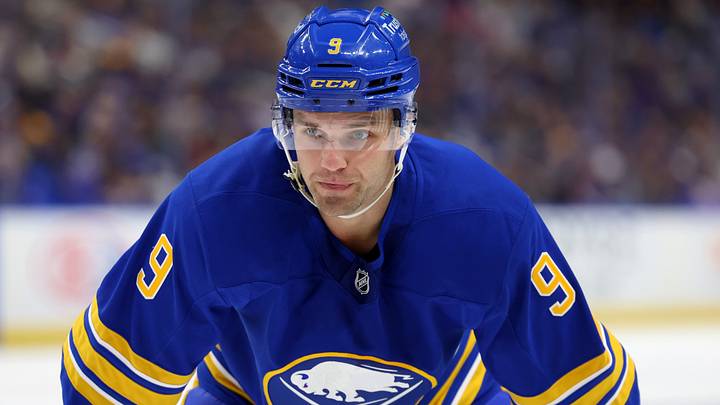
As another NHL offseason winds toward its conclusion, it appears the Buffalo Sabres front office will once again come up empty in its search for a proven No. 1 center.
The battle to fill that key spot on the depth chart will be firmly in the spotlight during Sabres training camp and Tage Thompson, who's filled the role by default on most occasions in recent years, may be forced to spend another year in the middle, though he'd likely be more effective on the wing.
As always, Josh Norris could unlock another level for the Buffalo offense, but staying healthy has proved nearly impossible for the 27-year-old University of Michigan product.
Norris has never played more than 66 games in a season, which occurred with the Ottawa Senators in 2021-22, when he also posted career-high totals in goals (35) and points (55).
Last season, the 6-foot-2 pivot suffered an injury in the team's season-opening loss to the New York Rangers and missed nearly two months. He was sidelined again from mid-January through late February because of another ailment. He ultimately played just 44 regular-season games and spent more time sidelined during the 2026 Stanley Cup Playoffs.
Although he was productive when healthy, tallying 34 points (13 goals and 21 assists), it's hard to become overly reliant on him given the extensive injury history.
Nevertheless, Norris is the most logical option to open the season centering the first line if head coach Lindy Ruff wants to keep Thompson on the wing. It's been Ruff's preferred choice since it gives the team's best forward more offensive freedom and less defensive responsibilities.
Beyond the 2021 NHL All-Rookie Team selection, Buffalo's other options are Jiri Kulich, Konsta Helenius and Ryan McLeod.
Kulich is returning from missing most of last season with a blood clot. Helenius has a lot of long-term upside, but asking him to serve as a first-line center as a rookie would be a lot. And McLeod is far better suited for a middle-six role based on his time in Buffalo so far.
In turn, it'll probably come down to either Norris or Thompson, at least to open the campaign.
Sabres showed confidence in Josh Norris with under-the-radar offseason decision
While Norris' injuries have made him a frequent target of fan criticism, if the Sabres were eager to move him, they likely would have made a push to do so before July 1, when the 2017 first-round pick had a 10-team no-trade clause go into effect.
Keeping him past that date served as a silent vote of confidence from Buffalo general manager Jarmo Kekalainen.
It's still possible Norris is moved before his contract expires in 2030, of course. The Sabres just wouldn't have quite as much leverage in those hypothetical talks since players typically put the league's worst teams and least desirable locals on their lists.
The underlying numbers suggest keeping him is a worthwhile bet for the Blue and Gold.
Norris ranks in the 87th percentile among forwards in projected wins above replacement (WAR) based on a three-year weighted average from HockeyStats.com. That includes being in the 50th percentile of even-strength offense, 77th percentile of even-strength defense and 94th percentile of finishing.
It illustrates the type of high-end impact he's capable of making if he merely stays on the ice. It's certainly productivity in line with a mid-level No. 1 center.
The Sabres will remain hopeful he'll eventually be able to string together a few years where he's able to play at least 70, or maybe even 80, games. In the short term, it could really help the upstart club offset the loss of Alex Tuch up front.
Even if that happens, however, Buffalo shouldn't stop its pursuit of a top-line centerman. It made a push to land the St. Louis Blues' Robert Thomas before last season's trade deadline, and Thomas still feels like a perfect fit if he ever became available again.
Norris may remain in Western New York even if the Sabres made that type of blockbuster addition, but having him as a second-line center, which would represent a less-crushing blow every time he's forced out of the lineup, creates less downside risk for the organization.
For now, the question is how Buffalo's first set of forward lines will look when the reigning Atlantic Division champions open training camp later this month.
 Add us as a preferred source on Google