

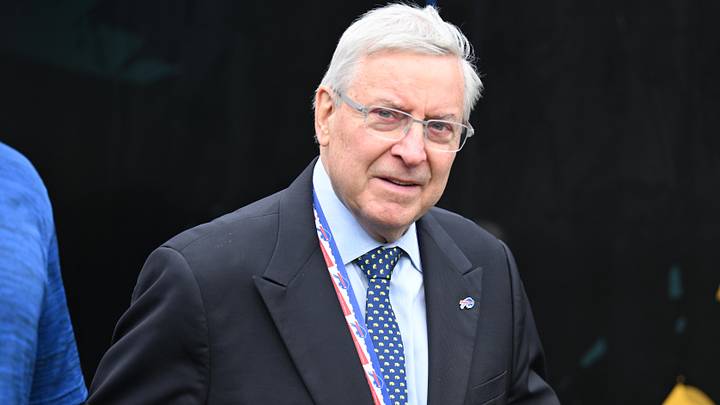
Buffalo Sabres owner Terry Pegula, a billionaire businessman who accumulated his wealth from the natural gas industry, once stated: "If we want to make some money, we'll go drill a gas well. We're not in this to save money."
Those comments, made during his introductory press conference in 2011, popped up frequently throughout the Sabres' NHL-record 14-year playoff because the organization often stopped short of spending every dollar available under the league's salary cap.
Now, as the franchise attempts to emerge as a Stanley Cup contender, Pegula's willingness to give the team's front office every resource necessary to compete will be tested. That's because the NHL salary cap is soaring, with Sportsnet's Frank Seravalli recently reporting it could reach $150 million by the 2029-30 season. It currently sits at $104 million.
That's a rapid increase, especially for a small-market team like Buffalo that can't match the revenue streams of its bigger-market foes. Will general manager Jarmo Kekalainen have clearance to spend all the way to the cap on a yearly basis?
On Wednesday, Harman Dayal of The Athletic wrote the Sabres are in an "enviable position with a ton of terrific contracts" but noted a lot of what comes next is up to Pegula:
"The bigger question for the Sabres is whether ownership will give them the green light to keep spending to the cap ceiling as it rises. You'd hope the answer is yes now that the team is competitive again — leveraging that extra cap flexibility could be key to elevating them into a bona fide Stanley Cup contender in future years."Harman Dayal on Terry Pegula
Buffalo has done some smart business in recent years, starting with former GM Kevyn Adams and continuing with Kekalainen. It's locked up a lot of core players to long-term contracts that grow more team friendly with each increase of the salary cap.
Yet, salaries will continue to rise and the Sabres probably need at least one or two more superstars (a true No. 1 center tops the shopping list) if they're going to chase down the NHL's elite. Attracting, and keeping, that level of player will be costly.
It's going to take a firm financial backing from Pegula — a $46 million uptick in annual spending within a three-year window is noteworthy, even to a billionaire — if the organization is going to maintain the upward trajectory it's been able to achieve at long last.
Another remark Pegula made 15 years ago? "Starting today, the Buffalo Sabres' reason for existence will be to win a Stanley Cup."
It's a dream that's remained elusive, and fans will find out in the coming years whether his commitment to that cause remains as steadfast as it was when he took over.
Jack Quinn is emerging as the next big test for the Sabres front office
A year ago, many Sabres supporters were ready to move on from Jack Quinn. The enigmatic winger had scored just eight points over the club's first 20 games of the 2025-26 season, and the 30-goal potential the franchise had been banking on the since the 2020 draft felt like a pipe dream.
Boy, how things have changed.
Quinn, who surged during the second half of last season to finish with a career-high 51 points, showed up to training camp with an undeniably improved compete level. He's parlayed that into a tremendous start to the new campaign with 14 points (eight goals and six assists) in 14 appearances, which puts him on pace for 48 goals.
The breakout is coming at a perfect time for the 25-year-old Canadian, who's scheduled to become a restricted free agent next offseason.
Quinn will be due a massive raise from his current $3.375 million salary if he comes anywhere close to matching that level of production over the course of the entire season. Will the Sabres be prepared to reward him with a lucrative long-term extension?
It was understandable when Buffalo walked away from discussions with Alex Tuch. While the power forward's presence has been sorely missed this season, paying the Syracuse native his unwavering $10.5 million asking price deep into his 30s would have come with ample risk.
The Sabres also traded away Bowen Byram after it became clear he wanted an opportunity to become a No. 1 NHL defenseman (and the $12.5 million contract that came with such high billing). Again, it's hard to blame Kekalainen for that course of action.
Not paying Quinn would be an entirely different conversation given his age and where the franchise stands in its contention window. It'll be a major test of the club's financial wherewithal, assuming the rapidly improving forward keeps playing at this level over the next six months.
All eyes will be on Kekalainen (and Pegula) if that's the case.
 Add us as a preferred source on Google