

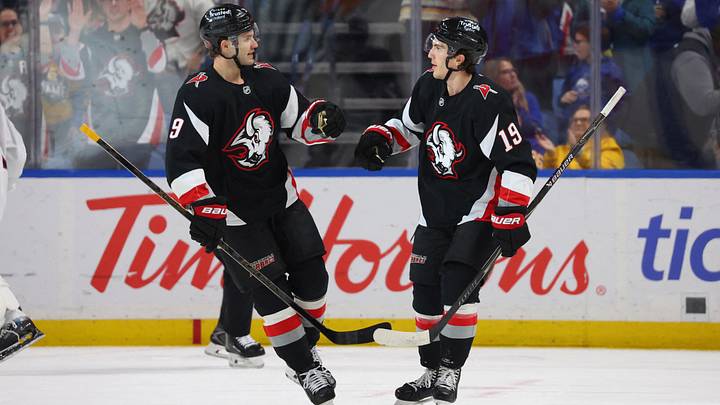
Buffalo Sabres head coach Lindy Ruff will be tasked with trying to make the team's lineup puzzle fit together as well as it did last season despite the high-profile departures of Alex Tuch and Bowen Byram, who were both traded over the summer.
A lot of young players are going to see their ice time increase, including wingers Zach Benson and Josh Doan, while new arrivals Olen Zellweger and Louis Crevier are expected to make an immediate impact on the blue line. Prized forward prospect Konsta Helenius is also ready for a full-time NHL spot.
Not every member of the Blue and Gold is moving up the organizational depth chart, though. Some players are probably heading for less minutes in 2026-27 as Ruff tries to strike the right balance between ascending players and proven veterans.
So, let's examine who could be heading for a smaller role, at least early in the campaign.
Peyton Krebs
Krebs is an ultimate team player, which is why the Sabres signed him to a four-year, $18 million contract extension in mid-July. He's willing to play anywhere in the lineup and isn't afraid to stand up for his teammates, even if he has to fight a bigger, stronger opponent.
The 25-year-old forward simply isn't strong enough offensively to deserve a first-line role, a reality that came back to haunt Buffalo during its second-round playoff series against the Montreal Canadiens. He finished with zero points and a minus-five rating in seven games against the Habs.
Ruff felt Krebs brought a hardworking element alongside Tuch and Tage Thompson but, ultimately, you need your top trio to score in big moments. The 5-foot-11 Canadian hasn't done that consistently enough, often being an offensive black hole throughout his six-year NHL career.
When the Sabres are healthy, Krebs should spend almost all of his time on the fourth line. Putting him alongside Sam Carrick and Beck Malenstyn should make for an effective group, and there will probably be moments where he slides up into the middle six because of injuries.
He shouldn't occupy a spot on the first line if Buffalo is serious about emerging as a Stanley Cup contender.
Jason Zucker
Zucker was a wise free-agent addition by former Sabres general manager Kevyn Adams. He's recorded 98 points (45 goals and 53 assists) in 135 games across two seasons with the franchise, and he's often been one of the team's most effective players on an otherwise struggling power play.
His involvement already started to decline late last season, however, and it carried over to the postseason. He played over a minute less per game in the playoffs (14:33) than he did during the regular season (15:37) as his point production dipped considerably.
The 34-year-old battle-tested veteran will probably open the season on the third line, and he'll probably be mostly a power-play specialist. The Sabres have other options with more upside, like Helenius, Noah Ostlund and Jiri Kulich, who are prepared for bigger 5-on-5 roles.
Zucker will also be an impending unrestricted free agent, so it's possible he's moved before the 2027 NHL trade deadline if Buffalo's young players acclimate well to their increased ice time.
Zach Metsa
Metsa, 27, finally earned his first NHL opportunity last season and mostly held his own en route to 43 appearances for the Sabres.
The former Quinnipiac University didn't make much of an offensive impact (six points), though. His other numbers, including a plus-16 rating, were bolstered by some underlying luck that earned him the nickname, the "PDO God." That's usually an untenable path to success.
Zellweger and Crevier join a defense group that also features Rasmus Dahlin, Owen Power, Mattias Samuelsson and Conor Timmins. Those six will almost surely be on the ice for Opening Night barring an injury during camp or the preseason.
That'll leave Metsa to compete with Dennis Gilbert for the No. 7 defenseman reserve role. It's quite possible he opens the year with the AHL's Rochester Americans.
He'll probably receive some time with the Sabres in 2026-27, but it feels unlikely he'll top 40 games for a second straight year.
 Add us as a preferred source on Google