

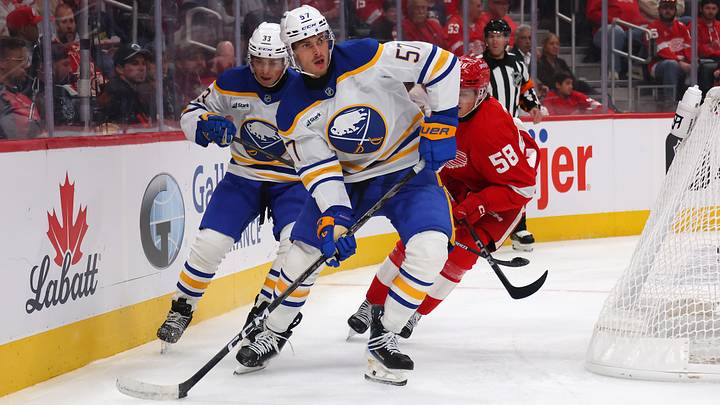
A quick glance at the Buffalo Sabres' organizational depth chart reveals a meaningful imbalance between the forwards and the defensemen.
Buffalo has five blueliners under contract for at least three seasons: Rasmus Dahlin, Owen Power, Mattias Samuelsson, Olen Zellweger and Louis Crevier. The franchise is also loaded with defensive prospects owning legitimate NHL aspirations, led by Daxon Rudolph, Radim Mrtka, Adam Kleber, Luke Osburn, Maxim Strbak, Gavin McCarthy and David Bedkowski.
That's a lot of talent. Far too much to ever end up on the same roster. In fact, outside of Rudolph, who's continued to see his stock skyrocket with a terrific start to his college career at the University of Denver, there isn't a clear path for those other prospects to wear the Blue and Gold.
It's a completely different conversation up front.
The Sabres graduated the likes of Zach Benson, Noah Ostlund, Jiri Kulich and Konsta Helenius to the NHL in recent years. They also have one offensive cornerstone in Tage Thompson, with Jack Quinn making a bid to become a foundational piece with a strong start to the 2026-27 campaign.
Their forward prospect pool isn't as promising, though. They have some potential middle-six wingers (Jake Richard, Brodie Ziemer and Prokhor Poltapov), while Ilia Morozov could eventually become a highly dependable second- or third-line center.
But nobody in the organization, either currently in the NHL or trying to make their way to hockey's highest level, can fill perhaps the most important role: No. 1 center.
Buffalo general manager Jarmo Kekalainen appears aware of that fact. He tried to land St. Louis Blues center Robert Thomas ahead of last season's trade deadline and has been active trying to join the Dylan Larkin sweepstakes, though the Detroit Red Wings star hasn't added Buffalo to his trade list.
At some point, Kekalainen needs to use that embarrassment of riches on the blue line to acquire a true first-line center, a void left unfilled since Jack Eichel departed Western New York in 2021.
There's simply no way the Sabres can accommodate all of those promising defensemen and, as the Ryan Johnson situation illustrated, the longer you keep previously prized prospects in the minor leagues, the more their perceived value begins to fade around the league.
Add in Buffalo's offensive struggles early in the current campaign, and it feels like now is the perfect time for the club's front office to get ultra aggressive trying to make a blockbuster deal.
Daxon Rudolph's NCAA success adds more clarity for the Sabres
Buffalo may have wanted to wait for Rudolph, the No. 4 overall pick in the 2026 NHL Draft, to showcase his talents against older, stronger college competition before shaking up their future blue line.
The 18-year-old Canadian has made a seamless transition for the Pioneers, tallying 12 points (six goals and six assists) across his first 12 NCAA appearances. He's already established himself as a high-leverage player for No. 3 ranked team in the country.
As a result, it continues to seem like Rudolph will be capable of making the NHL jump next season, which essentially locks in the club's depth chart barring an unexpected move:
Left Defense | Right Defense |
|---|---|
Mattias Samuelsson | Rasmus Dahlin |
Owen Power | Daxon Rudolph |
Olen Zellweger | Louis Crevier |
Zach Metsa continues to serve as the No. 7 defenseman, though Kleber figures to push him for that role once he makes a move to the pro game.
Meanwhile, Zellweger could ultimately stay with Power on the second pair, but the above alignment gives the Sabres the most all-around balance on the back end.
It leaves one key question: What happens with Mrtka?
The No. 9 overall pick in the 2025 draft simply hasn't developed offensively. He scored just one goal in 48 games (regular season plus playoffs) against WHL competition with the Seattle Thunderbirds last season and he's yet to record a point in 13 games with the AHL's Rochester Americans in 2026-27.
Was Mrtka drafted to become a Dahlin-style offensive play-driver? No, but there's a difference between not developing into a high-scoring defenseman and struggling to score at all, even if there's still optimism about his future D-zone impacts.
It goes back to trying to maximize value. The longer the 19-year-old Czechia native's performance in the AHL remains below expectation, the less interest he'll attract on the trade market. Is it better to consider moving him now, or continue betting he'll eventually find his game at that level?
That's not an easy question to answer but, given the Sabres' high number of defense prospects moving through the system, he shouldn't viewed as untouchable.
Between Mrtka, the Sabres' 2027 first-round pick and a couple NHL centers who could be used as trade chips (Josh Norris and/or Ryan McLeod), that's a strong basis for a package.
Kekalainen has utilized a measured approach since taking over the Buffalo front office last December, but it may be time for that to change to find some proven, battle-tested scoring help.
 Add us as a preferred source on Google