

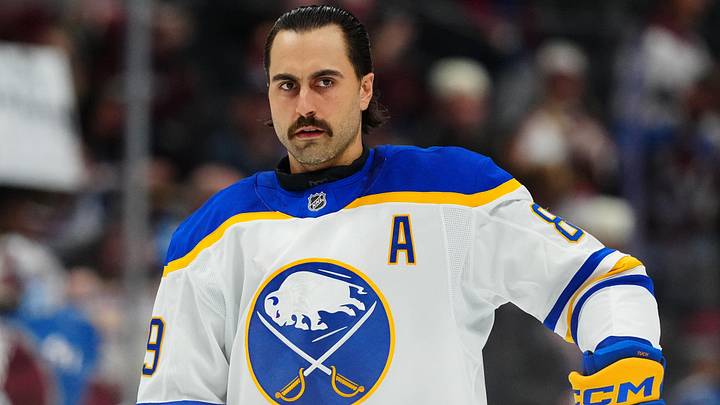
Details continue to trickle out about the 12-month contract negotiations between the Buffalo Sabres and Alex Tuch, who's set to become an unrestricted free agent if an extension agreement isn't reached within the next five weeks.
Rory Boylen of Sportsnet reported Monday the initial offer from the Sabres' front office, when it was still being led by former general manager Kevyn Adams, was around $8 million per season. That's a significant gap from Tuch's rumored asking price of about $10.5 million annually.
"But given the cap inflation, team needs and scarcity on the open market, we can reasonably presume Tuch will sign somewhere for $10 million or more," Boylen wrote.
In March, NHL insider Elliotte Friedman noted on the 32 Thoughts podcast that Buffalo's "new regime's budged a bit" in discussions since Jarmo Kekalainen took over the GM chair, but it still hadn't reached a point where both sides were comfortable with the extension offer.
The Sabres have since ended the longest playoff drought in NHL history (14 years), captured an Atlantic Division title and reached the second round of the 2026 Stanley Cup Playoffs.
Tuch complicated the discussions by failing to score a single point in the club's Round 2 postseason departure at the hands of the Montreal Canadiens in seven games. Even one goal by the 30-year-old winger could have changed the complexion of the tightly contested series.
His ill-timed second-round struggles combined with Buffalo's tight salary-cap situation this offseason could make it difficult for Kekalainen to give the three-phase contributor anything close to the eight-year, $84 million contract he's looking for before free agency arrives.
Alex Tuch's contract stance is understandable despite it clouding his Buffalo Sabres future
Tuch, who grew up rooting for the Sabres, made his personal priorities clear amid conversations about whether he'd consider a "hometown discount" to remain in Western New York.
"I'm going to do whatever's best for myself and my family," Tuch told reporters at his season-ending press conference. "That's all. That's my power and consideration. I don't know how talks are going to proceed. I don't know what they're going to say. I don't know the future. But my main priority is my family and where we'll be, where my kids will grow up and who we surround my kids with."
It's hard to blame the 6-foot-4 power forward for wanting to maximize his next deal.
First, he's provided value far beyond his contract since joining the Sabres in 2021 as the cornerstone piece of the Jack Eichel blockbuster trade. His $4.75 million salary was one of the NHL's biggest bargains as he racked up 309 points (139 goals and 170 assists) in 360 games for the club.
Second, this likely represents the 30-year-old winger's last chance to cash in on a lucrative long-term extension. A rising salary cap combined with his status as likely the best forward available in this year's free-agent class should ensure he could cash in handsomely on the open market.
Tuch won't tarnish his Buffalo legacy if he merely accepts the highest monetary offer made to him this summer. That's his right. He never complained about his below-market contract in recent years, and now it's time for him to earn some of that money back.
Meanwhile, Kekalainen and the Sabres have to do what's best for the organization, which may ultimately be wishing the American star all the best at his next NHL stop.
Buffalo's first order of business this offseason should be re-signing rising star Zach Benson to an extension similar to the one given to winger Josh Doan (seven years, $48.65 million) in January, and the front office also expressed interest in a new deal for defenseman Bowen Byram.
The Sabres will also want to retain center Peyton Krebs, and the coming years will require new contracts for Noah Ostlund, Jiri Kulich and Konsta Helenius.
As a result, paying Tuch what he wants will have a significant trickle-down effect not only this summer, which the Blue and Gold must navigate with only $12.9 million in available cap space (via PuckPedia), but in the seasons ahead, as well.
It's also hard to imagine a scenario where an eight-year contract for Tuch will age well into his mid- and upper-30s. While a short-term extension at the same price point would be a different story, there's no indication he's willing to consider that type of agreement.
So, it's a situation where the best decision for both sides may be merely going their separate ways. Tuch deserves to get paid and the Sabres have a bright future they must protect by maintaining at least some level of financial flexibility.
Perhaps a blockbuster trade before July 1 to create significant cap space could change the equation but, at least for now, it feels like an extension may be out of reach.
 Add us as a preferred source on Google