

In April 2013, when it became clear the Buffalo Sabres would require a full-scale rebuilding effort, general manager Darcy Regier delivered a quote that will live on forever in the franchise's lore.
"It may require some suffering," Regier said during an infamous season-ending press conference.
Somewhere along the line, "some suffering" transformed into 14 years of misery. The Sabres endured the longest playoff drought in NHL history, including several seasons where the team wasn't even remotely competitive (sometimes by choice due to tanking).
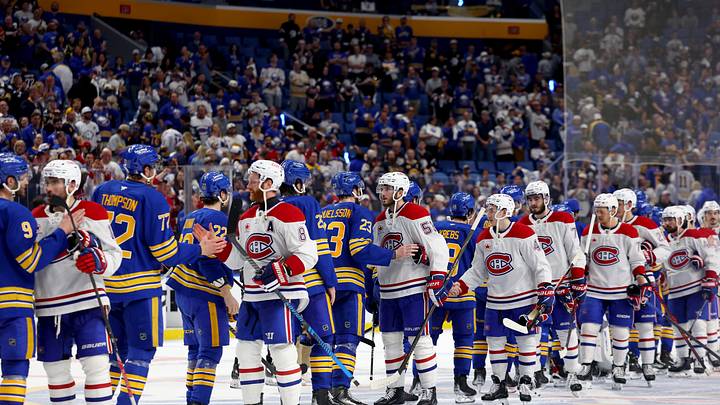
The pain and suffering finally ended this season, as Buffalo rebounded from a sluggish start (11-14-4 through 29 games) to win an Atlantic Division title and finally earn a postseason berth. It proceeded to knock out the Boston Bruins in the first round of the Stanley Cup Playoffs before falling short in Game 7 against the Montreal Canadiens on Monday night, bringing an end to a memorable campaign.
Regier, who's rarely spoke publicly about the Sabres since his tenure as GM ended in November 2013, discussed the club's return to the playoff stage with Matthew Fairburn and Pierre LeBrun of The Athletic.
"Buffalo is a great hockey town!" Regier told The Athletic. "The fans there have stayed loyal through a long stretch, and they deserve every bit of this. I'm genuinely happy for them. And there is a special feeling for the people who are still or again part of that organization — Lindy [Ruff] and others I had the privilege of working alongside."
Ruff was in his first tenure as Sabres head coach while Regier led the front office. He returned in 2024 with the goal of helping lead the organization out of the Dark Ages. Mission successful.
Meanwhile, Darcy Regier joined the Arizona Coyotes front office in 2014. He spent two years with the Yotes before stepping aside in 2016 for personal reasons. He's never returned to the NHL in executive capacity.
Focus shifts to current Buffalo Sabres general manager Jarmo Kekalainen after club's elimination from 2026 NHL Playoffs
It's no coincidence the Sabres' turnaround began around the same time rumors emerged that team owner Terry Pegula was preparing to make a GM change, ultimately firing Kevyn Adams and promoting Kekalainen to take over the front office.
Kekalainen brought a much-needed tone change to the organization. He pushed a no-nonsense approach, a sharp deviation from Adams' love of making excuses for why the team underperformed.
Buffalo's core responded to the challenge and emerged as one of the NHL's best teams, winning 39 of its final 53 regular-season games to skyrocket up the standings. Fans returned to the KeyBank Center in droves and playoff hockey finally made its way back to Western New York.
The work is just getting started, though.
The Sabres' series loss to a talented Canadiens squad showed they aren't quite ready to handle the league's elite, a group currently led by the Carolina Hurricanes and Colorado Avalanche, for a variety of reasons.
Buffalo's most pressing concerns are goaltending, as Ukko-Pekka Luukkonen and Alex Lyon both faltered in the playoffs after promising runs during the regular season, and the need for one more high-end offensive weapon, preferably a first-line center.
The Sabres can't enter a "happy to be here" stage. They shouldn't attempt to "run it back" with the same roster and expect to suddenly reach the same level as the Canes and Avs.
They probably wouldn't be able to anyway. Alex Tuch, who didn't register a single point in seven second-round outings against the Habs, is an impending unrestricted free agent. Either he'll be gone or the front office will need to make other roster changes to make the winger fit under the salary cap.
Buffalo also has eight other free agents to worry about: UFAs Beck Malenstyn, Logan Stanley, Josh Dunne, Luke Schenn and Tanner Pearson along with RFAs Zach Benson (the highest priority of them all), Peyton Krebs and Michael Kesselring.
Add in the fact the Sabres have just $12.9 million in projected cap space (via PuckPedia) and changes are likely afoot, whether Kekalainen wanted them or not.
So, the pressure quickly relocates from the players trying to hunt down a Stanley Cup to a veteran general manager — he previously held the role from 2013 through 2014 with the Columbus Blue Jackets — who needs to aggressively seek out roster upgrades with limited financial flexibility.
Kekalainen proved throughout his time in Columbus that he's not afraid to take bold swings when the situation warrants, and now feels like a perfect time to swing for the fences in Buffalo.
The Sabres were linked to St. Louis Blues center Robert Thomas ahead of the 2026 NHL trade deadline in March. Circling back to those conversations feels like a great place to start since he'd fit perfectly for what the Blue and Gold need up front.
Whether it's Thomas or someone else, Buffalo should make a serious push to land another top-six game-changer before the 2026-27 campaign gets underway.
As for the goaltending, the Sabres need to clear out a logjam that features UPL, Lyon, Colten Ellis and Devon Levi. At this point, it's impossible to feel completely confident any of them are the full-time, long-term answer between the pipes, so it could turn into a significant crease overhaul.
All told, Buffalo took a magnificent leap from a longtime NHL also-ran back toward Cup contention this season, but the unforgettable campaign didn't yield a storybook ending.
So it's back to the drawing board for Kekalainen with Sabres fandom now fully reignited.
 Add us as a preferred source on Google