

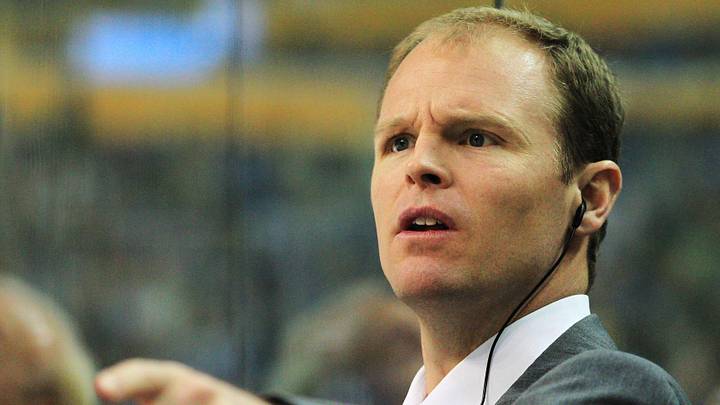
Former Buffalo Sabres general manager Kevyn Adams acquired many of the players who helped the franchise end its miserable 14-year playoff drought this season, but he wasn't a member of the organization when that moment of relief finally arrived.
Adams was fired in December as team owner Terry Pegula promoted Jarmo Kekalainen to the GM role with the club holding a 14-14-4 record. The Sabres proceeded to win 36 of their final 50 games to capture an Atlantic Division title.
Yet, despite some of the longtime Clarence resident's roster-building successes, he often struggled to publicly explain the team's slow progress. The most infamous example came in December 2024 when he said Buffalo is "not a destination city right now."
"We don't have palm trees," Adams told reporters at the time. "We have taxes in New York, and these are things you deal with.'
The Sabres fanbase didn't take kindly to those excuses. They responded by bringing inflatable palm trees to the KeyBank Center in wake of the remarks.
Adams spoke with Pierre LeBrun of The Athletic about Buffalo's long-awaited breakthrough, saying he's "so, so happy" for the franchise, and admitted he'll handle situations like the "palm trees" comments differently if given another NHL front-office opportunity.
"You learn from every situation," Adams told LeBrun. "There are things, when I look back, that I've learned I would do differently the next time I'm in that chair, for sure. But the biggest part for me that was challenging with that (comment) is that I love my hometown. I'm so proud of being from Buffalo. Everything about the organization and what it means to the city, that’s why I'm so proud that I was in that job and now seeing the success that the team is having."
The 51-year-old former NHL player, who won a Stanley Cup title with the Carolina Hurricanes in 2006, noted it was a failed effort to explain the team's stalled progress at the time.
"For me, it's always about trying to be as transparent and honest with how we were doing things and help the fans understand what our plan was and why," Adams said. "But yeah, as I've gone over everything the last couple of months, there's certainly things that I'd say, 'Next time when I'm in that chair and in that chair position, I might do them differently.'"
Here's a free bit of advice for Adams: Nobody cares about excuses.
He became an excuse-making machine far too often throughout his six seasons in Buffalo rather than accepting personal responsibility, and he gained a reputation of being too soft on the players, which created an environment where it was hard to hold anybody accountable.
Kekalainen instantly changed the entire organizational vibe, and it wasn't a coincidence that coincided with the Sabres going on one of the best regular-season runs in NHL history.
If Adams does receive a second chance to lead a front office — he recently interviewed with the Vancouver Canucks, but wasn't chosen for the role — those two factors will be crucial to success: better handling of the public-facing aspects of the job and creating a more accountable locker room.
When the going gets tough, Adams needs to accept responsibility for the failures, even if it's not entirely his fault, and work through the hurdles that come with the position rather than using them as a crutch for why the results are falling below expectations.
He proved capable of making good roster decisions — nobody is going to bat 1.000 — but his time in Buffalo should have taught him a lot about the other aspects becoming a successful GM.
Kevyn Adams' replacement, Jarmo Kekalainen, faces a critical offseason to make the Buffalo Sabres a sustainable contender
The Sabres finally made it back to the NHL playoffs, and now the real work begins.
Kekalainen must find a way to transform a roster that made a lot of progress over the past nine months into a true Stanley Cup contender for next season and beyond.
He'll immediately face a franchise-altering decision, too. Should Buffalo re-sign Alex Tuch, a foundational piece of the organization who's reportedly seeking a long-term contract with an annual salary around $10.5 million, or let him hit the free-agent market?
There isn't a perfect answer. Tuch would be difficult to replace. He provided key contributions at even strength, on the power play and on the penalty kill. There aren't a ton of players around the league who can handle all three phases so seamlessly.
Yet, paying any player a double-digit AAV into their late 30s comes with a massive amount of risk since it's highly unlikely the contract will age well. The 6-foot-4 power forward also didn't do himself any favors by tallying zero goals and zero assists across seven games in Buffalo's second-round playpff series against the Montreal Canadiens.
That's not the only tough decision for Kekalainen, either.
The Sabres have eight other impending free agents: Beck Malenstyn, Logan Stanley, Luke Schenn, Josh Dunne and Tanner Pearson (all UFAs) as well as a trio of RFAs in Zach Benson, Peyton Krebs and Michael Kesselring.
Buffalo must also decide whether to shake up its goaltending group after Ukko-Pekka Luukkonen and Alex Lyon both faltered in the postseason.
Yet, while the first instinct after falling short in the playoffs is to make significant changes, it's important to remember how successful the Sabres were this season. Finishing second in the Eastern Conference after being .500 through 32 games is highly impressive.
The Sabres have a lot of the pieces for long-term success already in place. Now it's up to Kekalainen to make the right additions to push the club toward championship contention.
His decisions this summer will tell an important tale about whether he's capable of handling that task.
 Add us as a preferred source on Google